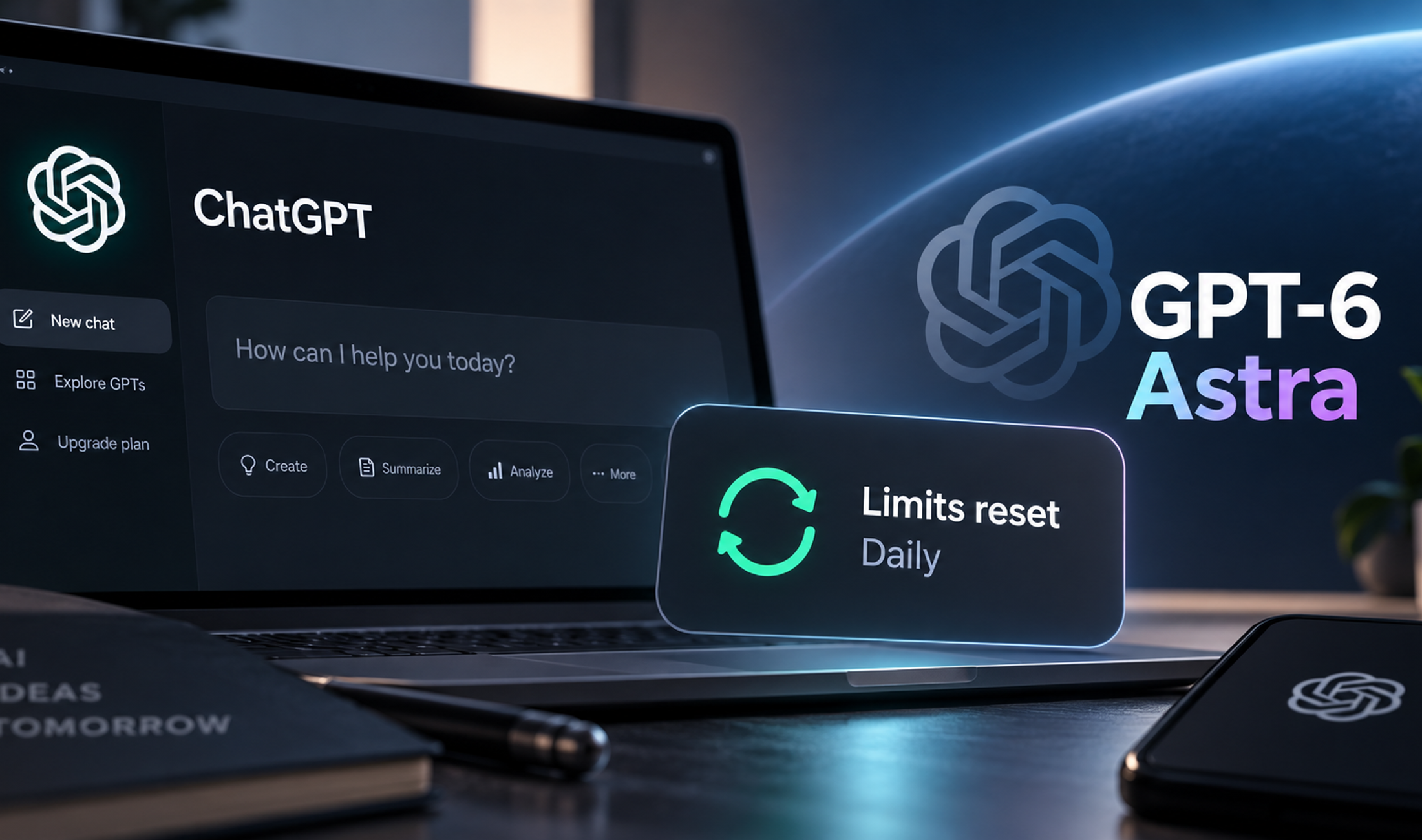
Some ChatGPT users are seeing usage allowances reset on a daily or rolling basis just as OpenAI begins the rollout of GPT-6 Astra. That has sparked a simple question: is OpenAI temporarily giving everyone fresh limits every day until Astra reaches their account?
The short answer is no, at least based on the evidence available now. OpenAI has not announced any special “daily reset until Astra arrives” promotion. What users are seeing is better explained by ChatGPT’s normal plan-based usage allowances, which can reset on daily, weekly or rolling windows depending on the model, plan and product.
Verdict: the Astra-linked daily reset claim is unverified
There is currently no official OpenAI announcement saying ChatGPT limits are being reset every day as a temporary benefit until GPT-6 Astra becomes generally available. OpenAI’s help documentation explains that allowances reset according to the model and plan you are using, and ChatGPT shows the applicable reset time when that information is available.
OpenAI’s current ChatGPT model and limits documentation says some models have their own allowances and that reaching a limit can make a model temporarily unavailable until that allowance resets. It does not connect those resets to the Astra rollout.
Why users may think ChatGPT is resetting every day
There are several reasons the rumour feels believable. ChatGPT does not use one universal limit for every feature. Different models and tools can have different usage windows, and the timing can change by plan.

For example, reasoning models may have a separate allowance from ordinary Instant chats. Pro-class models can have daily or weekly limits. ChatGPT Work and Codex use separate controls from normal ChatGPT conversations. File uploads, image generation, voice and data analysis can also have their own limits.
As a result, a user might hit one limit, return the next day and find that access has returned. If that happens during a highly visible model rollout, it is easy to assume the two events are connected even when the reset is simply the scheduled allowance refreshing.
What OpenAI actually says about GPT-6 Astra
OpenAI announced GPT-6 Astra on September 3 and said broader ChatGPT access will roll out over the coming days. Astra is initially reaching a limited set of organisations, with wider availability planned for eligible paid users rather than appearing everywhere at once.
That staggered rollout is important. Two people on the same broad subscription tier may not see Astra at exactly the same time. Availability can also differ between normal ChatGPT, ChatGPT Work and Codex.
Headline Thread has a separate explainer on GPT-6 Astra’s features, pricing, rollout and safety changes, including why OpenAI is treating the model as a major step toward more autonomous computer-based work.
Are Free and Go users getting unlimited ChatGPT while they wait?
OpenAI’s current documentation says Free and Go users have unlimited everyday text chats, subject to abuse-prevention safeguards. That does not mean every ChatGPT feature is unlimited.
Uploads, image generation, voice, data analysis and GPT usage can still have separate limits. Some higher-capability models are also not included on Free and Go plans. So a user may be able to keep sending ordinary text messages while still being blocked from a specific premium model or tool.
This distinction can create another source of confusion. If ordinary chat keeps working after a premium allowance expires, it may look as if OpenAI has “reset” the account when in fact ChatGPT has simply fallen back to another available model or feature.
What happens on Plus, Pro, Business and Enterprise?
Paid plans have more complicated limits because they can include multiple model families, reasoning modes and premium features. OpenAI says usage limits depend on the plan, the model and, for managed workspaces, administrator settings.
On some Pro and Business configurations, higher-end models share allowances. Switching models does not necessarily create a fresh pool of messages. When an allowance runs out, the user can often use another available model or wait until the displayed reset time.
That is very different from OpenAI deliberately resetting all users every day as a launch countdown. The official documentation describes a standing usage-management system, not a temporary Astra promotion.
What about Work and Codex resets?
OpenAI also offers paid Work and Codex limit resets for eligible Plus and Pro personal accounts. These are purchased resets that restart a weekly usage period; they are not free daily resets tied to Astra.
This matters because screenshots showing a reset date or a newly available allowance can circulate without the surrounding plan details. A reset message by itself does not prove that OpenAI has changed everyone’s limits.
Where the rumour likely comes from
The rumour appears to be a combination of three real things: Astra is rolling out gradually, ChatGPT displays reset times for some allowances, and users on different plans can regain access at different times. Put together, those facts can look like a coordinated daily refresh even though OpenAI has not described one.
There is also a timing effect. When a major model launches, users pay much closer attention to model pickers, limit counters and reset notices. Normal account behaviour that might otherwise go unnoticed suddenly becomes part of speculation about the rollout.
How to check your actual ChatGPT reset time
The most reliable source is the limit message shown inside your own ChatGPT account. OpenAI says ChatGPT displays the reset time when that information is available. Because allowances can vary by plan and model, another user’s screenshot may not apply to your account.
If one model is unavailable, check whether another model remains selectable. If a tool such as image generation or file analysis has hit a limit, ordinary chat may still work. For managed Business or Enterprise accounts, workspace settings can also affect what is available.
OpenAI also says Support cannot manually reset ordinary ChatGPT or Codex usage limits. If a displayed reset time has passed and access still has not returned, users can contact Support to investigate whether the usage was counted incorrectly.
Will these resets continue until Astra reaches everyone?
There is no official basis for saying they will. The only confirmed Astra timeline is that broader availability is planned over the coming days. OpenAI has not published a promise that current usage-reset behaviour will continue until every eligible account receives Astra.
If OpenAI changes model allowances during the rollout, those limits could also change again. Usage caps are operational settings that companies adjust based on demand, compute capacity and product policy. They should not be treated as a guaranteed launch benefit unless OpenAI explicitly says so.
What this means for users in India
Indian ChatGPT users should expect the Astra rollout to follow plan eligibility and account rollout timing rather than a separate India launch schedule unless OpenAI announces otherwise. Seeing a reset on one account does not mean Astra is about to appear immediately on that account.
For paid users, the practical advice is to watch the model picker and the reset time shown in-product. For Free and Go users, everyday text chat may remain broadly available while premium tools and models continue to have separate restrictions.
Bottom line
The claim that ChatGPT is giving users a free daily reset specifically until GPT-6 Astra arrives is not supported by OpenAI’s published information. Daily, weekly and rolling resets are part of ChatGPT’s normal plan and model allowance system.
Astra is rolling out gradually, and the timing has made ordinary reset behaviour easier to misread as a special promotion. Unless OpenAI announces a temporary Astra-linked reset policy, the safer interpretation is that users are seeing their existing usage windows refresh as designed.
Sources
OpenAI: GPT-5.6 and GPT-6 Pro in ChatGPT; OpenAI: ChatGPT release notes; OpenAI: ChatGPT Business models and limits; OpenAI: Paid Work and Codex rate limit resets.