
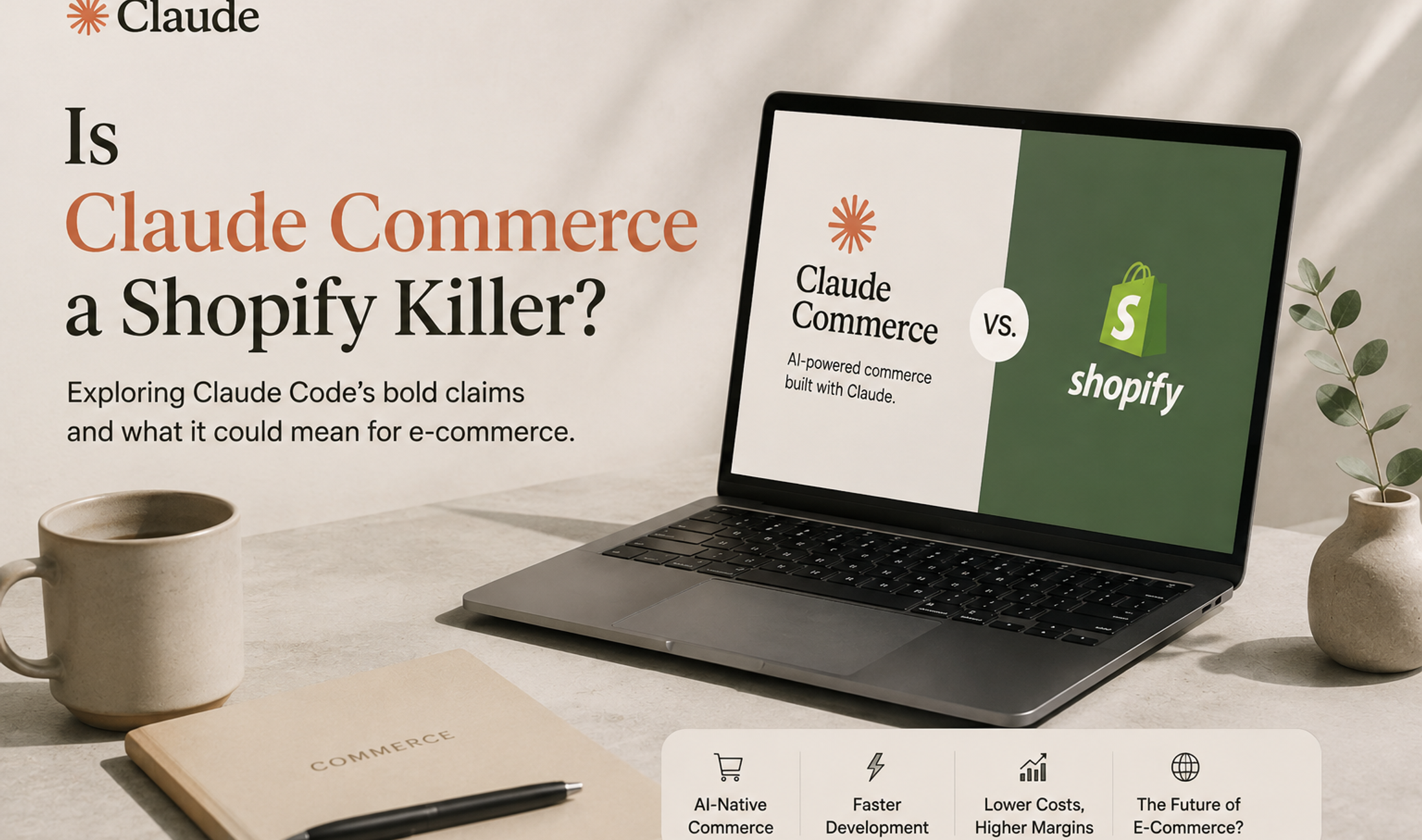
A new wave of posts around “Claude Commerce” is framing Anthropic’s Claude as a direct Shopify replacement, with some claims going further and suggesting Shopify has banned Claude Code internally because the AI tool is becoming too powerful. The story is attention-grabbing, but the available evidence points in almost the opposite direction.
Shopify is not publicly retreating from Claude. Anthropic’s own Shopify customer case study says Claude helps power Shopify’s Sidekick assistant and that Claude Code is heavily used across the company for internal tools. Shopify also offers an official connector that lets Claude manage store data and actions. At the same time, Shopify is building its own agentic-commerce infrastructure so merchants can sell through AI channels such as ChatGPT, Google Gemini and Microsoft Copilot.
Did Shopify ban Claude Code internally?
There is no credible evidence that Shopify has banned Claude Code internally. In fact, Anthropic currently publishes a Shopify case study that says the opposite. Andrew McNamara, Shopify’s Director of Applied AI, is quoted saying Claude Code is “pretty heavily used across the company” because it integrates with Shopify’s platform for quickly standing up internal tools.
Anthropic describes Shopify as having embraced “reflexive AI usage,” with engineers and non-engineers using Claude Code to build internal applications. The case study also says Shopify uses Claude models in Sidekick, its merchant-facing AI assistant. Anthropic’s Shopify case study is therefore strong primary-source evidence against the claim that Shopify broadly banned Claude.
That does not mean Shopify cannot restrict particular AI tools, data access or workflows for security reasons. Large companies routinely apply internal controls to AI usage. But a claim that Shopify has banned Claude Code company-wide needs evidence, and no such verified announcement could be found.
What is “Claude Commerce” actually referring to?
“Claude Commerce” is being used online as a convenient label for Claude’s growing ability to participate in ecommerce, but Anthropic does not currently present it as a standalone Shopify-style commerce platform. Anthropic has publicly said it is interested in agentic commerce, where Claude could act for a user to find, compare and eventually buy products or make bookings.

Anthropic has also experimented with AI agents negotiating real transactions. Its Project Deal experiment had Claude agents negotiate purchases and sales on behalf of employees. That work shows where Anthropic thinks AI-mediated commerce could go, but it is not the same thing as launching a full merchant platform with payments, tax, fraud prevention, inventory, fulfillment and checkout infrastructure. Anthropic’s own description of its commerce direction is still focused on supporting shopping and agentic transactions through Claude.
Claude can already operate a Shopify store through an official connector
The most important development is not Claude replacing Shopify, but Claude becoming a new interface for Shopify. Anthropic lists an official Shopify connector for Claude, Claude Code and the Claude API. It can create or update products, adjust inventory, create discounts, inspect orders and customers, and query store analytics.
Shopify’s own help documentation similarly explains that merchants can connect their stores to Claude and other AI tools. In other words, a merchant may increasingly manage Shopify by talking to an AI agent instead of clicking through every admin screen. The Shopify connector for Claude makes Claude a conversational control layer on top of Shopify, not a substitute for Shopify’s underlying commerce infrastructure.
Is Claude becoming “better at ecommerce” than Shopify?
The comparison is misleading because Claude and Shopify currently solve different layers of the ecommerce stack. Claude is a general-purpose AI model and agent interface. Shopify is a commerce operating system that handles catalog data, storefronts, payments, checkout, tax, fraud controls, order management and fulfillment integrations.
Claude may be better at interpreting a merchant’s natural-language request, reasoning across data, writing product copy, analyzing reports or carrying out a multi-step task. Shopify is better positioned to execute the commercial transaction because it owns or coordinates the infrastructure behind the store. The two products can therefore become more valuable together.
For example, a merchant could ask Claude to identify slow-moving inventory, create a discount campaign and update selected products. Claude handles the reasoning and instructions, while Shopify provides the authoritative product database, permissions, checkout and commerce APIs needed to make those changes real.
Shopify is preparing for AI shopping rather than fighting it
Shopify’s strategy suggests it expects AI assistants to become major shopping channels. The company has launched Agentic Storefronts, allowing merchant products to appear across AI experiences, and co-developed the Universal Commerce Protocol with Google to standardize how AI agents interact with merchants.
Shopify says millions of merchants can now reach shoppers through AI channels, while its Agentic plan allows brands that do not use Shopify for their main online store to add products to Shopify Catalog. Shopify’s agentic-commerce announcement makes the company’s defensive strategy clear: if shopping moves into AI conversations, Shopify wants to remain the commerce layer underneath those conversations.
This is similar to the broader platform shift Headline Thread examined in its OpenAI vs Cursor analysis: AI products are increasingly competing over the interface while still depending on infrastructure, models and ecosystems owned by other companies.
Is Claude making Shopify “go down”?
Current financial evidence does not support the idea that Claude or AI shopping is causing Shopify’s business to collapse. Reuters reported in August that Shopify shares jumped more than 18% after the company issued a stronger-than-expected revenue outlook. Shopify’s second-quarter revenue rose 34% year over year to about $3.58 billion, while gross merchandise volume increased 32% to about $115.6 billion.
Reuters also reported that AI-generated traffic and orders to Shopify merchants had tripled in the quarter, while daily active use of Shopify’s Sidekick assistant grew sharply. The August earnings report therefore suggests AI is currently helping Shopify’s growth story rather than destroying it.
The real threat AI poses to Shopify is more subtle
None of this means Shopify is safe from disruption. The real risk is that AI agents could reduce the importance of the traditional ecommerce storefront. If customers ask Claude, ChatGPT or Gemini to find the best product and complete the purchase, they may spend less time browsing a merchant’s homepage, collection pages and navigation.
That could move power toward whoever controls product discovery. AI systems may decide which products get surfaced, how alternatives are compared and which merchants receive traffic. Retailers also care about maintaining customer data and direct relationships, which is why many still prefer to complete transactions on their own checkout even when discovery starts inside an AI assistant.
For India, the same transition could eventually matter to millions of small online sellers as conversational interfaces become more common. The broader question is similar to the one in Headline Thread’s analysis of India’s AI infrastructure race: which companies own the models, data, compute and transaction layers that sit underneath everyday AI experiences.
Who wins if agentic commerce becomes the default?
The likely outcome is not a simple Claude-versus-Shopify winner. AI companies want to own the shopping conversation. Commerce platforms want to own merchant data, checkout and transaction infrastructure. Payment companies want to own settlement. Merchants want reach without losing their customer relationships.
That creates a stack in which Claude could become the interface a merchant or shopper talks to, while Shopify remains the system executing the commercial workflow underneath. Over time, those boundaries could shift. Anthropic could build deeper commerce infrastructure, and Shopify could make Sidekick increasingly autonomous. But that competition has not yet produced evidence that Claude has replaced Shopify.
Bottom line
The strongest version of the viral story does not hold up. There is no verified evidence that Shopify has banned Claude Code internally. Primary sources show Shopify actively uses Claude and Claude Code, offers a Shopify connector for Claude, and is building infrastructure specifically for the agentic-commerce era.
Claude is still important to Shopify’s future because it demonstrates how the ecommerce interface is changing. Merchants may increasingly manage stores conversationally, and shoppers may discover products inside AI assistants rather than visiting storefronts first. That is a real strategic threat to parts of the traditional ecommerce experience, but it is also an opportunity Shopify is trying to turn into another distribution channel.
Sources
Anthropic, Shopify customer case study on Claude and Claude Code.
Anthropic, Shopify connector for Claude.
Shopify, Agentic Storefronts and AI commerce announcement.
Reuters, Shopify August 2026 earnings and AI growth report.
Anthropic, statement on Claude and future commerce experiences.