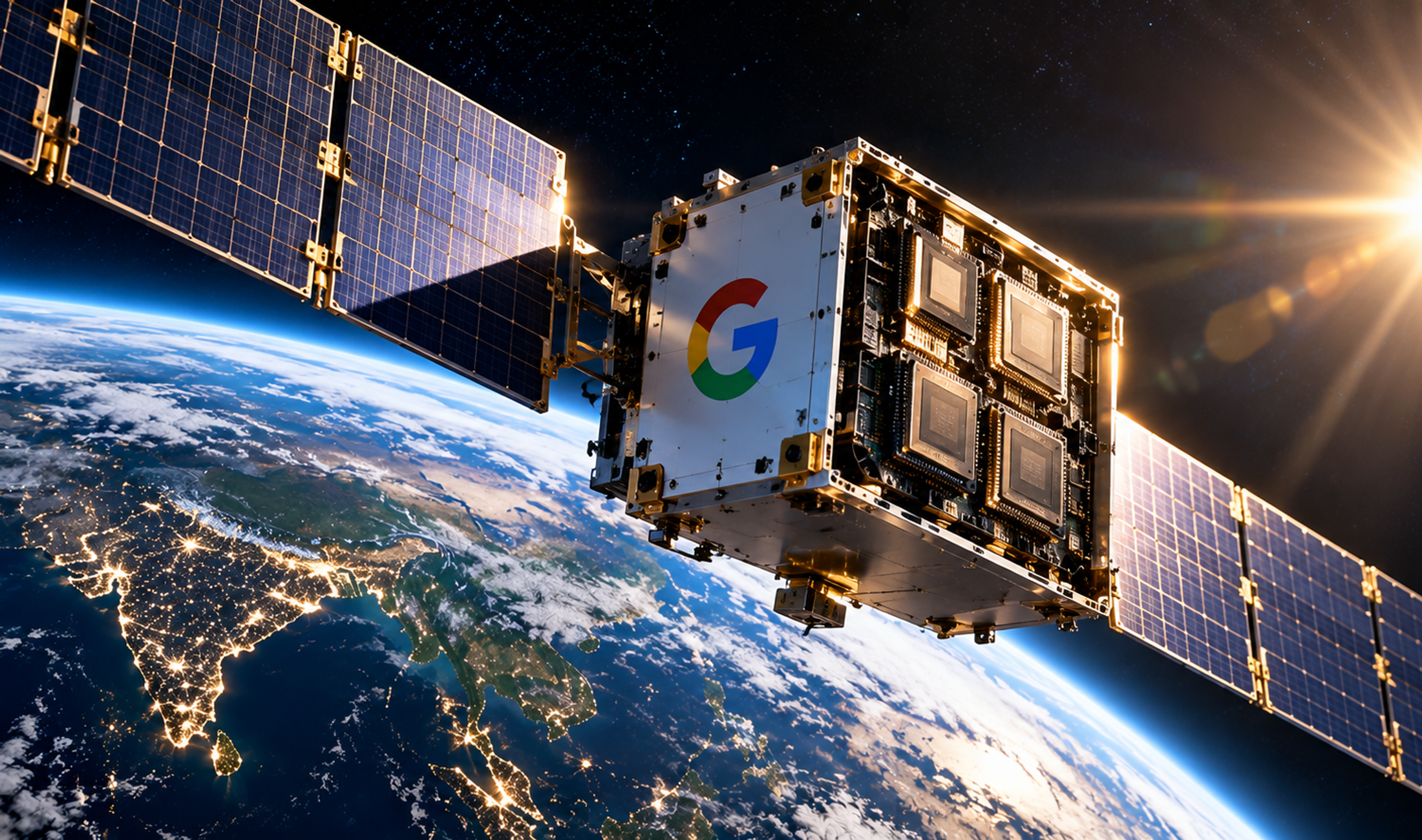
Google is moving Project Suncatcher from a research concept to hardware in orbit. The company says a prototype satellite built with Planet will fly on SpaceX’s Transporter-18 rideshare mission to test whether Google Tensor Processing Units can survive launch and operate reliably in low Earth orbit. The first flight is a hardware experiment, not a working space data centre.
That distinction matters. The most interesting question is not whether Gemini is suddenly moving off Earth, but whether the economics and engineering of AI infrastructure could eventually make orbital compute useful alongside terrestrial data centres.
What Google is actually testing
Google’s September 24 update says the prototype will evaluate how TPUs behave in the conditions that cannot be fully reproduced together on Earth. The team is particularly interested in launch vibration, radiation exposure and thermal management.
The long-term Suncatcher idea is much larger: clusters of satellites carrying machine-learning accelerators, powered by solar energy and connected by high-speed optical links. Google says a satellite in the right low-Earth orbit can receive near-continuous sunlight and potentially generate up to eight times as much solar power as a comparable panel installation on Earth.
But one prototype cannot validate that entire architecture. It can answer a more basic question first: can conventional high-performance AI hardware operate in space long enough to make the bigger idea worth pursuing?
Why putting AI compute in space is attractive
AI infrastructure is increasingly constrained by more than the price of chips. Large data centres need dependable electricity, grid connections, land and cooling capacity. Those constraints are becoming strategic considerations as companies build increasingly large clusters for training and inference.
India is seeing the terrestrial version of that build-out already. Microsoft’s new Hyderabad cloud region illustrates how hyperscalers are adding local AI-capable capacity while dealing with power, cooling, latency and data-residency requirements.
Orbit changes the energy equation because sunlight can be much more consistent. It also removes competition for terrestrial land. That sounds compelling, but it replaces familiar data-centre problems with harder aerospace problems.
Cooling may be harder than powering the chips
Space is cold in popular imagination, but vacuum does not provide the kind of cooling a server room gets from moving air or circulating water. Heat has to be conducted away from the chips and ultimately radiated into space. High-performance AI accelerators create a lot of heat in a small area, making thermal design one of Suncatcher’s central engineering tests.
Ars Technica reports that the experimental system will run Gemini workloads only in short bursts of roughly 15 minutes before the TPUs shut down so the radiator can catch up. That limitation is useful context: the first mission is testing whether the thermal design works, not demonstrating continuous cloud-scale AI service.
Radiation and reliability are the next barriers
Modern AI accelerators are designed for data centres, where radiation is not a primary engineering constraint. In orbit, energetic particles can damage hardware or cause transient errors. Google has already performed ground-based radiation testing, but the orbital flight gives engineers real operating data across radiation, temperature changes and launch stresses.
Reliability also changes when hardware cannot be serviced easily. A failed accelerator in a terrestrial data centre can be replaced. A failed accelerator in orbit may be effectively lost. Any economically useful orbital compute system would therefore need unusually strong fault tolerance, redundancy and remote management.
The network problem is just as important as the chips
A modern AI cluster is valuable because thousands of accelerators can exchange data at extremely high speed. Putting processors on separate satellites makes that interconnect problem much harder. Suncatcher’s long-term design therefore depends on optical links between spacecraft, not simply powerful chips attached to solar panels.
This is one reason readers should be skeptical of claims that the upcoming flight represents a data centre in space. A single satellite can test compute hardware and thermal behaviour, but it cannot prove that a large distributed orbital cluster will achieve the bandwidth, latency, reliability and cost required for serious AI training.
What Project Suncatcher means for India
There is no announced Indian Suncatcher deployment, and the upcoming experiment should not be read as an alternative to the data-centre capacity being built in India today. For Indian businesses, terrestrial cloud regions remain the relevant infrastructure for latency-sensitive services, regulated workloads and local data requirements.
The broader relevance is that Google is testing infrastructure for the same rapidly expanding AI ecosystem behind products such as Gemini. Headline Thread recently examined how Gemini was used in an autonomous security exercise, another example of AI workloads moving beyond conventional chatbot use cases.
If orbital compute eventually becomes viable, countries with strong launch, satellite and ground-station capabilities could participate in a new infrastructure layer. India has obvious space-sector relevance, but Google has not announced an ISRO partnership or India-specific role in Suncatcher. Any such connection would be speculation today.
What would count as a successful first mission?
Success does not require the satellite to prove that orbital AI data centres are commercially viable. A useful mission would show that the TPUs can survive launch, operate predictably under radiation exposure, execute real machine-learning workloads and provide engineers with enough thermal and reliability data to improve the next spacecraft.
Failure would also produce valuable information. Google describes the flight as an experiment intended to identify points of failure. That is a very different standard from a product launch.
The questions that remain unanswered
Even if the prototype performs well, Suncatcher still has to solve several problems before orbital AI can compete with Earth-based infrastructure: sustained cooling, high-bandwidth links between many satellites, launch economics, hardware replacement, collision risk, orbital debris, ground connectivity and the cost of operating a constellation.
The economics are especially important. Abundant solar energy does not make launch, spacecraft construction or maintenance free. A space-based system only becomes compelling if the total cost of delivering useful compute can compete with continually improving terrestrial data centres.
Bottom line
Project Suncatcher is worth watching because Google is now putting real AI hardware into orbit rather than limiting the idea to simulations. But the upcoming mission is best understood as a stress test for orbital computing, not the opening of a space-based Google Cloud region.
If the experiment works, it clears only the first of many technical hurdles. If it does not, the data may still reveal which parts of orbital AI are practical and which remain science fiction. Either outcome gives the industry something more valuable than a futuristic headline: evidence.