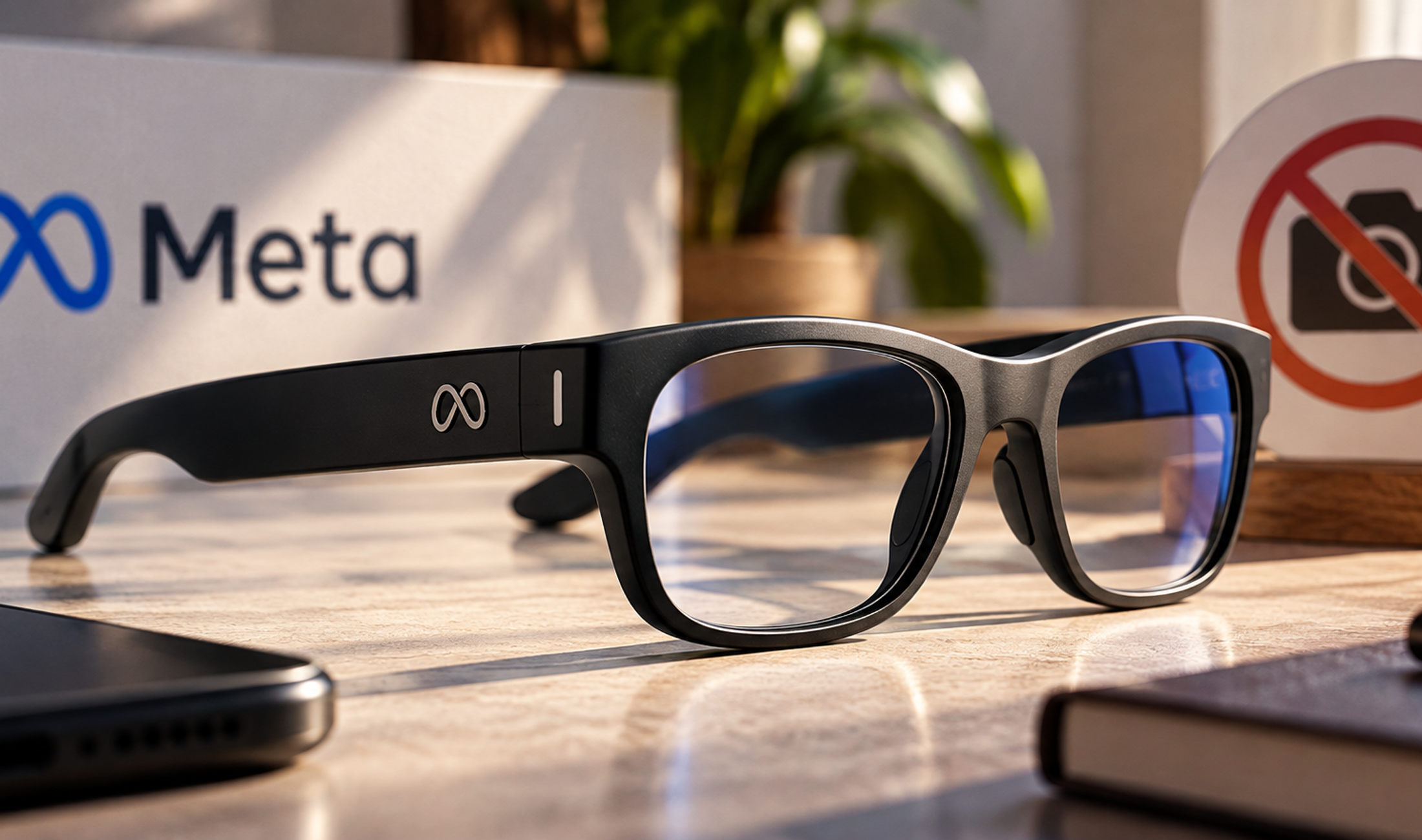
Meta has taken an unusual step in the smart-glasses race: it has removed the camera. At Meta Connect 2026, the company introduced Ray-Ban Meta Audio, a $349 pair of AI glasses built with EssilorLuxottica that keeps speakers, microphones and AI assistance but drops photo and video capture. According to Meta’s announcement, pre-orders begin October 13 in initial markets.
That sounds like a feature reduction, but it may be the more interesting product decision. Cameras are one of the biggest reasons smart glasses create discomfort for people around the wearer. Removing them gives Meta a way to keep the hands-free AI and audio experience while eliminating the most obvious recording concern.
What Ray-Ban Meta Audio actually keeps
The glasses are not simply Bluetooth headphones placed in a frame. Meta says they can play music and podcasts, handle calls, translate speech and provide access to Muse, its personal AI agent. Muse is designed to do more than answer one-off questions: Meta is positioning it as an agent that can help manage tasks and longer-term goals through voice interaction.
Meta claims up to 12 hours of battery life from the glasses and up to 48 hours with the charging case. At 43 grams, the camera-free design is also slimmer than Meta’s camera-equipped models. Buyers can choose prescription lenses, and Meta says there will be 23 colour and lens combinations across Clubmaster-inspired and rectangular Burbank styles.
The camera trade-off is bigger than it looks
Camera-equipped glasses are useful because the AI can see what the wearer sees. That enables visual questions, hands-free photos and first-person video. But it also means bystanders have to decide whether a person wearing ordinary-looking glasses might be recording. TechCrunch noted that Meta’s earlier safeguards included disabling the camera if the recording indicator LED was tampered with, yet concerns around covert recording persisted.
Ray-Ban Meta Audio removes that specific ambiguity. There is no camera to disable, cover or explain. The wearer gives up visual AI and capture features, but people nearby no longer have to interpret an LED to know whether the glasses can record video. For workplaces, schools, gyms and other sensitive environments, that could make the audio-only model easier to accept.
Camera-free does not mean privacy-free
Removing the camera solves only one part of the privacy problem. The glasses still rely on microphones for calls, voice commands, translation and AI interaction. Users therefore still need to consider when the microphones activate, what information is sent for processing, how account data is handled and which AI features require cloud access.
Meta has also announced a “private processing” capability for its glasses and says it is designed so Meta cannot see the data being processed. That is an important claim, but buyers should judge individual features by their documented data flows rather than treating the absence of a camera as a blanket privacy guarantee.
How it compares with regular Ray-Ban Meta glasses
Meta also announced Ray-Ban Meta Gen 3 at Connect. The camera model adds a 12MP camera capable of 3K Ultra HD video, a six-microphone array and up to nine hours of battery life. That creates a clearer product split than before: Meta Audio is for people who primarily want discreet audio and voice AI, while Gen 3 is for people who value visual AI and hands-free capture enough to accept a camera on their face.
There is also a battery argument for the simpler product. Meta’s stated 12-hour figure for Audio is three hours longer than the nine-hour figure announced for Gen 3. Real-world endurance will vary with calls, music and AI use, but the specification illustrates a practical benefit of removing camera hardware.
Muse could matter more than the missing camera
The longer-term bet is that glasses become a natural interface for an AI agent. A phone requires the user to take it out, open an app and look at a screen. Glasses can be available at the moment a thought occurs. That same shift toward more conversational assistants is visible in products such as Alexa+ in India, but glasses make the interaction wearable rather than room-based.
Muse integration is supposed to let users ask the glasses to help with tasks such as planning, appointments and shopping. Whether that becomes genuinely useful depends less on benchmark performance and more on reliability: an agent worn all day needs to understand short voice requests, preserve context, recover from mistakes and make it obvious before taking consequential actions.
What Indian buyers should know
Meta has not announced an India price or confirmed India availability for Ray-Ban Meta Audio. The $349 US starting price should not be converted directly into an expected Indian retail price because taxes, duties, lens configuration and local pricing can change the final figure. Indian buyers should wait for an official local listing rather than treating converted US pricing as a launch price.
The broader question is whether people want AI that is always within speaking distance. Wearables are moving in that direction across categories, including the latest Apple Watch generation. Meta’s advantage is that glasses are already something millions of people wear for hours. Its challenge is making the AI valuable enough that users accept another device that needs charging and account access.
Who should consider the audio-only version?
On the confirmed specifications, Ray-Ban Meta Audio makes the most sense for someone interested in open-ear audio, calls, translation and voice AI but uncomfortable wearing a camera. The camera-equipped Gen 3 is the more capable choice for creators and anyone who wants visual AI. People mainly interested in music and calls should still compare the glasses with conventional open-ear earbuds, which may cost less and avoid tying everyday eyewear to a technology platform.
That is what makes Meta’s camera-free experiment worth watching. Instead of asking consumers to become comfortable with cameras everywhere, it tests whether the strongest part of smart glasses may simply be a familiar frame that gives an AI assistant a persistent, hands-free place in daily life.