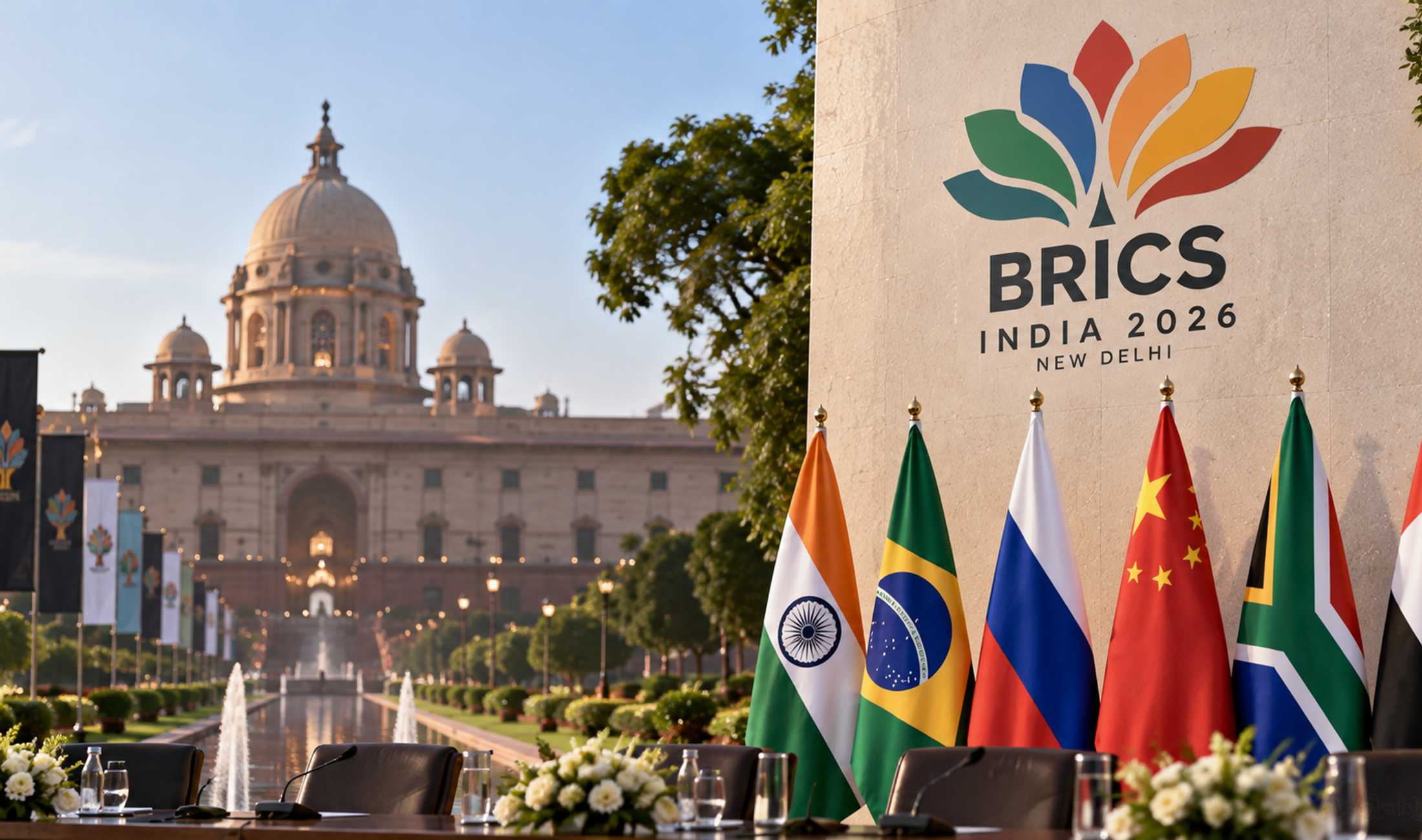
The 2026 BRICS Summit in New Delhi has produced its central outcome: leaders unanimously adopted the New Delhi Declaration despite sharp differences over the Middle East war, trade restrictions and geopolitical alignments. The agreement matters for India because it turns several priorities of its BRICS chairship into a common 11-member position rather than leaving them as host-country proposals.
The declaration covers conflict resolution, terrorism, unilateral tariffs and sanctions, reform of global institutions, greater use of local currencies and interoperable payment systems, artificial intelligence, health, agriculture and development. It also shows where BRICS stopped short: there is no common BRICS currency, and the language on the Middle East remains deliberately cautious.
What the BRICS New Delhi Declaration says
The declaration was adopted by consensus on September 12 during the 18th BRICS Summit at Bharat Mandapam. That consensus was not guaranteed. Iran is a BRICS member, while the United Arab Emirates is also inside the grouping and has been directly affected by the regional conflict. The final text calls for maximum restraint and emphasizes dialogue, consultation and diplomacy rather than allowing those differences to prevent a joint statement.
That is a significant diplomatic result for India as summit host. Reuters reported that Iran and the UAE both backed the statement, even as the war has divided countries across the region.
BRICS pushes back against unilateral tariffs and sanctions
Trade is one of the declaration's most consequential economic sections. BRICS members raised concern about unilateral tariff and non-tariff measures and reaffirmed support for a multilateral trading system. The position is particularly relevant as sanctions, tariffs and export restrictions increasingly affect energy, commodities and supply chains.
For India, these geopolitical risks are already economic. Recent disruption to Saudi oil infrastructure has added to concerns around crude supply, inflation and the import bill.
Local currencies and payments move forward, but there is no BRICS currency
The declaration supports deeper use of local currencies in trade and investment and greater interoperability between national payment systems. That is a more practical path than creating a single BRICS currency. The bloc is focusing on making existing payment networks work together more easily while strengthening the New Development Bank and reducing friction in cross-border transactions.
For Indian readers, the distinction is important: the summit did not announce a replacement for the rupee or a new shared BRICS currency. The near-term agenda is payment connectivity and settlement in national currencies.
Terrorism and the Pahalgam attack
The declaration condemns terrorism and includes strong language against terrorist attacks, while Indian reporting on the final text highlights specific condemnation of the Pahalgam attack and support for zero tolerance toward terrorism. This was one of New Delhi's major diplomatic priorities going into the summit.
Global governance reform and a bigger role for the Global South
Prime Minister Narendra Modi used the summit to argue that the Global South should become a rule-shaper rather than a rule-follower. BRICS backed reform of international institutions to give developing economies greater representation, including changes to global financial governance and the United Nations system.
The summit also provided a stage for bilateral diplomacy. Modi and Xi Jinping used their meeting in Delhi to push business links, mobility and border stability, adding an India-China dimension to the broader BRICS agenda.
AI, health and agriculture also make the final text
The declaration extends well beyond geopolitics. BRICS members called for cooperation on artificial intelligence that is safe, inclusive and responsive to developing-country needs. India also secured practical initiatives in health and agriculture, including a BRICS network of mental-health Centres of Excellence coordinated by Bengaluru's NIMHANS and new cooperation on climate-resilient agriculture, digital agriculture and farmers' rights.
Why the New Delhi Declaration matters for India
India entered the summit facing a difficult balancing act: it maintains important relationships with the United States, Russia, Iran, the UAE and China while also dealing with an oil shock and renewed pressure on trade and supply chains. Getting an expanded BRICS to sign one declaration under those conditions gives New Delhi a tangible diplomatic outcome.
The economic backdrop remains important. India's foreign-exchange reserves have climbed to a record level, but the rupee and oil prices remain closely watched as the Middle East conflict affects global markets.
What happens next
The test now shifts from declaration language to implementation. Watch for concrete work on payment-system interoperability, local-currency settlement, New Development Bank financing, the proposed governance-reform roadmap and India's new BRICS cooperation initiatives. The summit continues on September 13, so additional bilateral meetings and implementation announcements can still add detail to the political agreement reached in New Delhi.