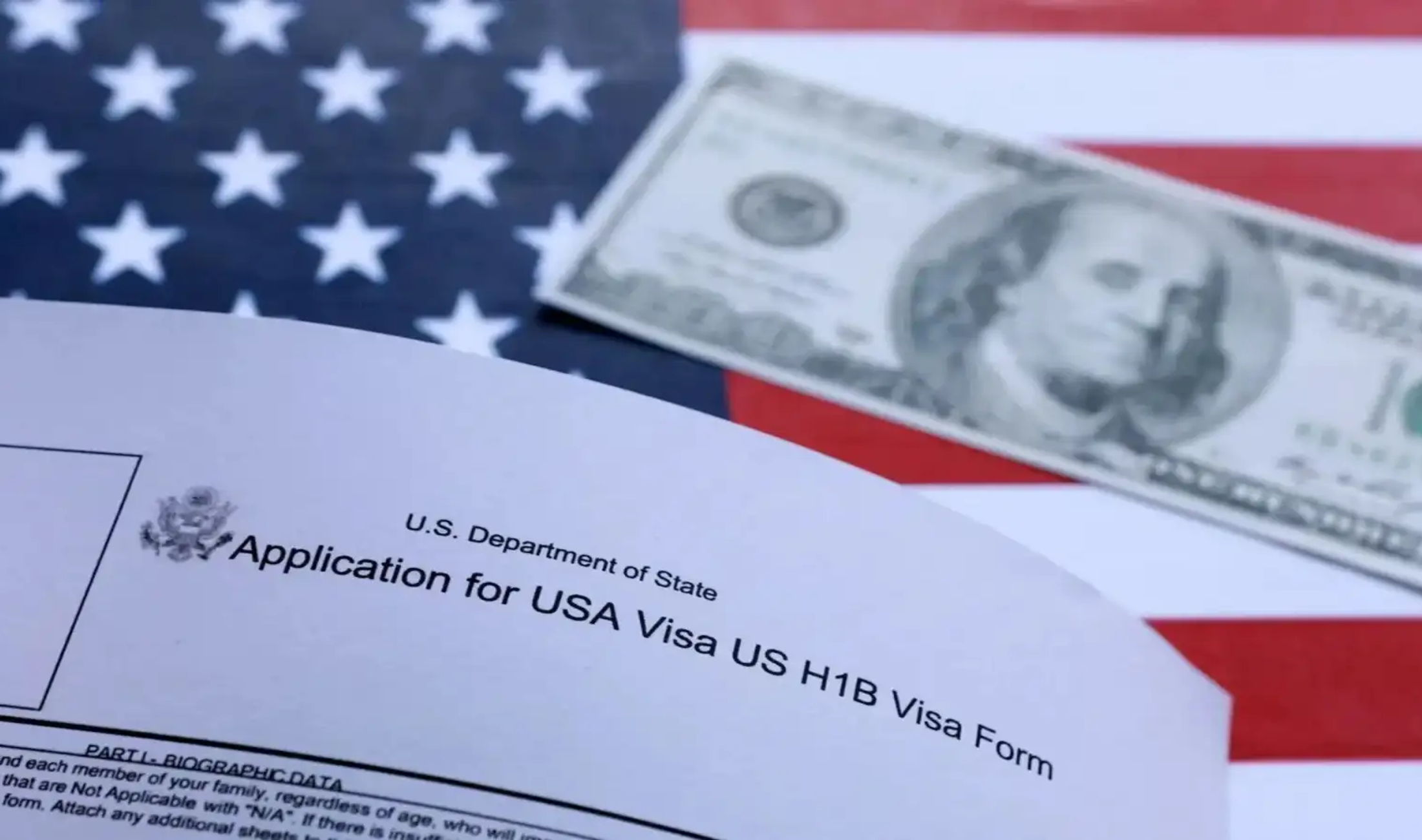
US President Donald Trump has extended restrictions on the H-1B visa programme for another year, keeping a controversial $100,000 payment requirement in place for certain new H-1B workers seeking entry to the United States. The extension was announced on September 18, 2026 and keeps the policy alive while major legal challenges continue.
The change is especially important for India because Indian nationals account for the largest share of H-1B approvals and the programme is heavily used by technology, consulting and engineering employers. However, the headline figure does not mean every H-1B holder or renewal applicant suddenly owes $100,000.
What Trump Extended on H-1B Visas
Reuters reported on September 18 that Trump extended the executive order for another 12 months. The policy restricts entry for certain H-1B workers unless the sponsoring employer makes a $100,000 payment. Reuters says the measure was originally introduced as part of the administration's effort to make employers pay substantially more when bringing new skilled foreign workers into the country.
Traditional H-1B filing costs are far below $100,000, although the total varies by employer and petition. The six-figure payment therefore changes the economics of sponsoring some overseas hires, particularly for smaller companies and jobs where an employer has several alternative hiring locations.
Who Does the $100,000 Requirement Affect?
The restriction is not a blanket $100,000 charge on everyone already holding an H-1B visa. Reuters reports that current holders converting from student visas and people renewing existing H-1B visas are excluded from the extended entry restriction. The practical focus is therefore on certain new workers entering the United States under H-1B status.
That distinction matters for Indian professionals already working in the US. Existing status, extensions and individual immigration circumstances should not be treated as identical to a new overseas hire. Workers should rely on the applicable USCIS rules and professional immigration advice for their specific case rather than assuming the headline fee applies to them personally.
Why the Extension Matters for Indian Tech Workers
Indian professionals are disproportionately exposed to any major H-1B policy change. US government data for earlier years has consistently shown India as the dominant country of birth among approved H-1B beneficiaries, reflecting the deep connection between the programme and India's software and engineering workforce.
A $100,000 payment can make employers more selective about which roles justify overseas sponsorship. Scarce-skill positions and senior technical jobs may remain economical, while entry-level or easily relocated roles could face more pressure. That does not necessarily eliminate the work. Some employers can instead expand US local hiring, move projects to India or use other global delivery centres.
The timing is notable because the US remains India's largest market for software services. It also comes while Washington and New Delhi are dealing with wider trade friction. Headline Thread's coverage of the new US Russia sanctions law and India's tariff exposure shows how immigration and trade policy are increasingly overlapping with the economics of India's technology and services sectors.
The $100,000 H-1B Policy Is Still in Court
The extension does not settle whether the payment requirement will survive judicial review. Reuters reports that a Boston appeals court is considering the administration's appeal after a federal judge found the fee hike unlawful. A separate court is also considering litigation involving a challenge backed by the US Chamber of Commerce.
That means employers and applicants face an unusual combination of a policy that the administration intends to keep in force and unresolved litigation that could alter or invalidate it. The legal outcome is therefore as important as the one-year extension itself.
How Companies Could Respond
Large technology companies can absorb higher immigration costs more easily than startups, but even the biggest employers have incentives to reconsider where jobs are located. Reuters noted that companies including Alphabet have adjusted hiring strategies amid policy uncertainty, with some activity expanding in India.
For Indian developers and engineers, that could produce two opposing effects. US sponsorship may become harder for some candidates, while more high-value work could be performed from India. Headline Thread's guide to AI jobs and skills in India looks at the specialised areas where employers are already competing for talent.
What Indian H-1B Applicants Should Watch Next
The first thing to watch is the appeals process because a court ruling could materially change the payment requirement. The second is implementation guidance defining exactly which petitions and entry situations are covered. The third is employer behaviour during the next H-1B hiring cycle, which will show whether companies reduce sponsorship, concentrate it on higher-paid jobs or shift more roles outside the US.
For now, the clearest takeaway is that Trump has extended the H-1B restriction for another year, but the $100,000 requirement is not a universal personal fee for every H-1B worker. Its biggest immediate effect is on the economics of certain new employer-sponsored hires, while the courts may still determine how long the policy ultimately survives.