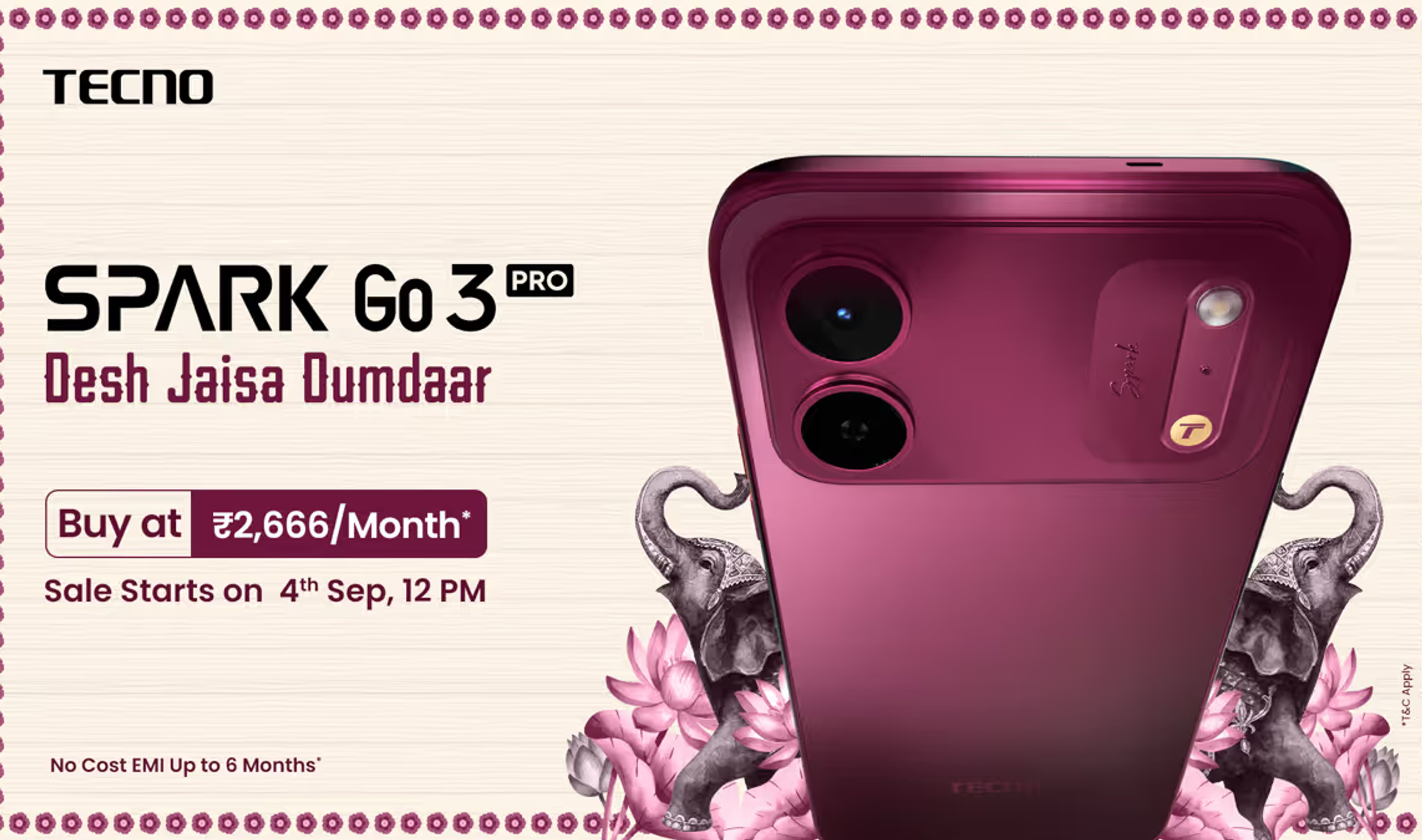
Tecno has launched the Spark Go 3 Pro in India at a starting price of ₹15,999, giving budget-phone buyers an unusual trade-off. Instead of chasing 5G or a faster processor, Tecno is making durability the headline feature with an IP69-rated body, while also offering a 120Hz display, a 5,200mAh battery and an infrared blaster.
That makes the Spark Go 3 Pro interesting for a very specific kind of buyer. It is aimed less at people trying to maximise benchmark performance and more at commuters, outdoor workers and users who worry about dust, rain, splashes or rough everyday handling. The important question is whether those practical advantages are worth accepting 4G-only connectivity at a price where 5G phones are already common.
Tecno Spark Go 3 Pro price in India and sale date
The Spark Go 3 Pro costs ₹15,999 for the 4GB RAM and 64GB storage model. The 4GB RAM and 128GB storage variant is priced at ₹16,999. Sales are scheduled to begin in India on September 4 through offline retail partners as well as Amazon and Flipkart.
Because the phone has not yet gone on sale, buyers should avoid treating any marketplace listing, discount or exchange figure as permanent. Launch-day pricing, seller availability and bank offers can change quickly, so the official retail price is the safest reference point for now.
What the Spark Go 3 Pro actually offers
The phone uses a 6.78-inch HD+ IPS LCD with a 120Hz refresh rate, 240Hz touch sampling rate and quoted brightness of up to 580 nits. A 120Hz panel should make scrolling and interface animations look smoother than a conventional 60Hz screen, although the HD+ resolution reminds you that this is still an affordable device rather than a display-focused mid-ranger.
Processing is handled by MediaTek's Helio G81 chipset with 4GB of RAM. That is enough for messaging, social media, video streaming, navigation and other routine smartphone tasks, but buyers should not expect the sort of gaming headroom or long-term performance margin available from stronger 5G chipsets in competing phones.
The rear camera is a 13MP autofocus unit, while the front uses an 8MP sensor. Tecno also includes dual speakers with DTS support and AI Voiceprint Noise Cancellation, which is designed to reduce background noise during voice calls. An IR blaster lets the phone act as a remote for compatible televisions, air conditioners and other appliances.
IP69 durability is the real reason to consider this phone
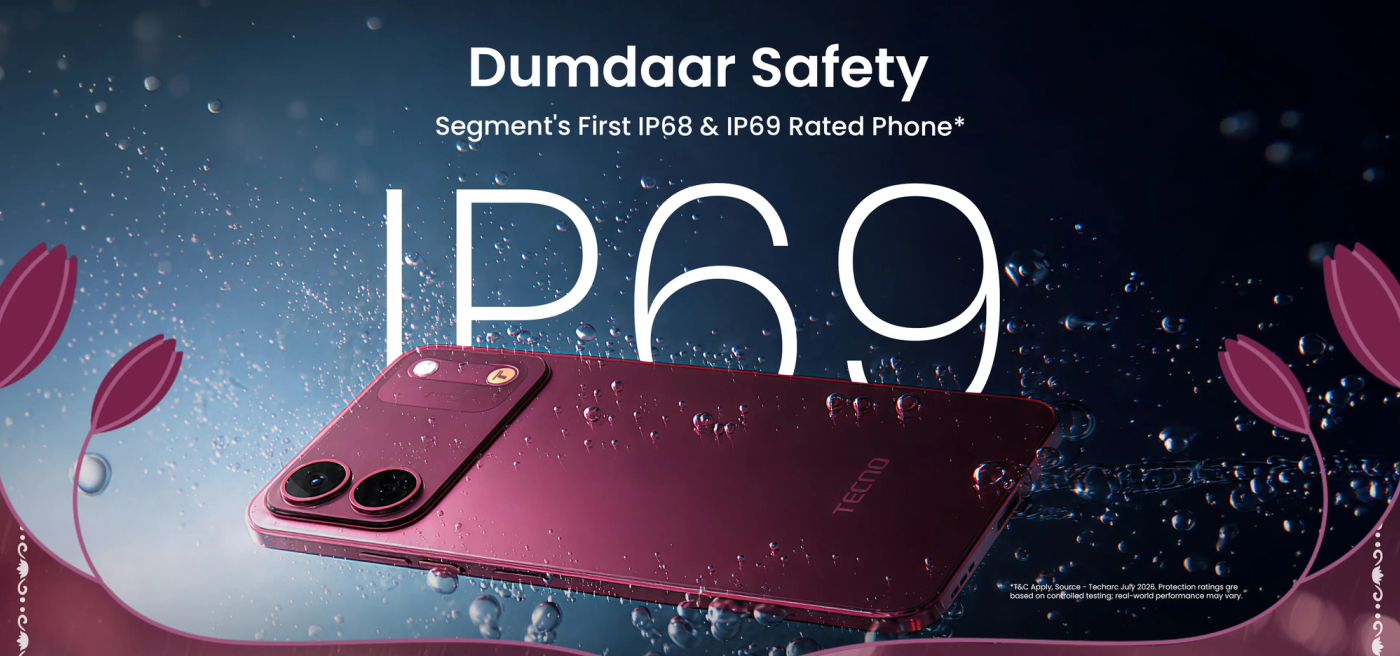
IP69 is the Spark Go 3 Pro's standout feature. The rating indicates a high level of protection against dust and high-pressure, high-temperature water jets under controlled test conditions. That is more aggressive protection than the basic splash resistance commonly associated with inexpensive smartphones.
That does not make the phone indestructible or guarantee protection from every kind of liquid damage. IP testing is performed under defined laboratory conditions, and real-world wear can affect seals over time. Still, for people who regularly work outdoors, commute during monsoon weather or use a phone in dusty environments, the rating has more practical value than another small specification-sheet upgrade.
This positioning also separates the Spark Go 3 Pro from many rivals around the same price. Affordable phones usually compete on battery size, cameras, display refresh rate or 5G support. Tecno is betting that some Indian buyers will prioritise a tougher build instead.
The biggest drawback is simple: there is no 5G
The Spark Go 3 Pro remains a 4G smartphone. That is difficult to ignore in 2026 because 5G is no longer limited to premium devices. Buyers around this price can find 5G options, and that matters if you plan to keep the phone for several years or regularly use mobile data in areas with strong 5G coverage.
The decision therefore depends on what you value more. Someone buying primarily for durability may accept 4G. Someone focused on network longevity, faster downloads or better future-proofing should compare 5G alternatives before spending. Our Pixel 11 vs Pixel 11 Pro comparison shows the opposite end of the Android market, where software, cameras and AI features dominate the buying decision rather than ruggedness.
Battery capacity is solid, but charging is modest
A 5,200mAh battery powers the Spark Go 3 Pro, which is a sensible capacity for this class. The modest chipset and HD+ display should help keep power demands under control, although actual endurance will depend on signal strength, brightness, refresh-rate behaviour and usage patterns.
Charging tops out at 15W. That is functional rather than fast by current standards. If you regularly need a quick top-up before leaving home or between shifts, faster-charging alternatives may be more convenient. The larger appeal here is likely dependable everyday battery life rather than rapid charging.
A 120Hz display sounds premium, but resolution still matters
The 120Hz refresh rate is a welcome feature because it improves perceived smoothness when navigating menus and scrolling. However, refresh rate should not be confused with image sharpness. The panel is still HD+, so text and fine details will not look as crisp as on a Full HD+ screen of a similar size.
For buyers who mostly watch short-form video, browse social media and use messaging apps, that compromise may be acceptable. Anyone who spends a lot of time reading, editing documents or streaming high-resolution content should compare displays in person before deciding.
Who should buy the Tecno Spark Go 3 Pro?
The Spark Go 3 Pro makes the most sense for buyers whose phone is exposed to tougher-than-average conditions. Delivery workers, field staff, frequent two-wheeler commuters and users in dusty or rainy environments may get genuine value from the IP69 rating. The large display, dual speakers, IR blaster and 5,200mAh battery also make it a practical everyday device.
It can also suit someone who mostly uses Wi-Fi and 4G, does not play demanding games and values physical resilience over benchmark performance. In that scenario, Tecno's priorities line up reasonably well with the buyer's needs.
Who should skip it?
Skip the Spark Go 3 Pro if 5G connectivity is important, if you want strong gaming performance, or if display sharpness matters more than refresh rate. Buyers who plan to keep a phone for four or five years should think particularly carefully about buying a new 4G-only model in 2026.
If you are changing devices, it is also worth checking India's current telecom requirements. Our guide to the new SIM card rules in India explains the recent changes and the limits that apply to mobile connections.
What this launch says about India's budget-phone market
The Spark Go 3 Pro is a reminder that inexpensive smartphones no longer have to compete on exactly the same checklist. As 5G and large batteries become increasingly common, brands need another reason to stand out. Tecno is using durability as that reason.
That strategy also fits a broader Indian market where local manufacturing, distribution and price-sensitive competition continue to shape product decisions. Headline Thread's explainer on India's ₹62,500 crore mobile manufacturing scheme looks at the policy backdrop influencing the country's smartphone ecosystem.
Early verdict: useful niche, difficult price competition
At ₹15,999, the Tecno Spark Go 3 Pro is not an obvious recommendation for everyone. A 4G-only phone at this price has to justify itself, and Tecno is trying to do that with IP69 protection, a 120Hz display, a 5,200mAh battery and practical extras such as an IR blaster.
For buyers who genuinely need a more rugged everyday phone, that combination could make sense. For mainstream buyers who simply want the strongest all-round smartphone for the money, 5G alternatives deserve serious consideration. The final choice comes down to whether durability is a core requirement or merely a nice feature to have.