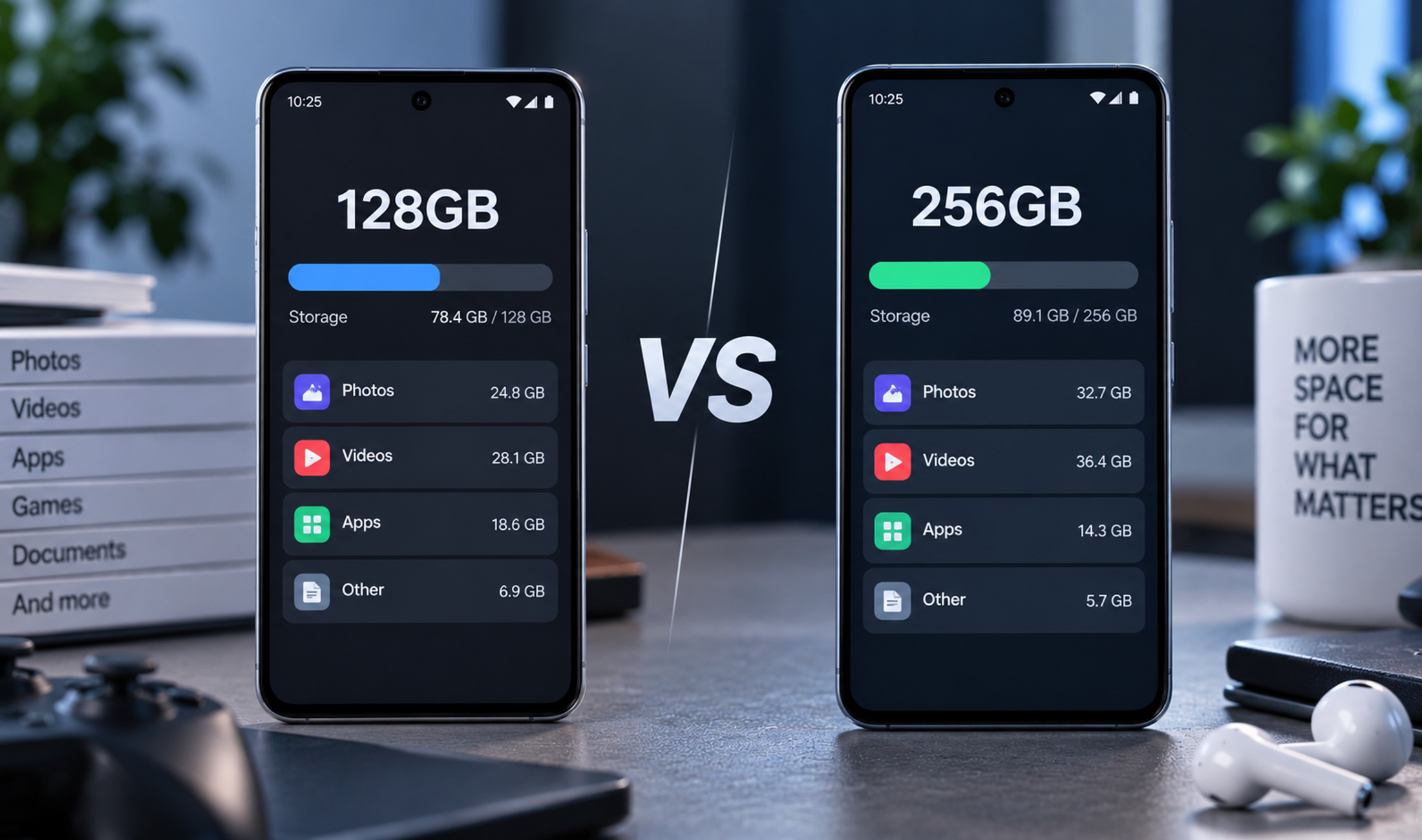
Phone storage is easy to underestimate because 128GB looks enormous when a device is new. A few years later, the same phone may be carrying thousands of photos, 4K videos, WhatsApp media, downloaded music, streaming downloads, large games and increasingly capable AI features. That is why choosing between 128GB and 256GB is less about today's free space and more about how you expect to use the phone over its lifetime.
For many Indian buyers, 128GB remains perfectly usable in 2026. But 256GB has become the safer long-term choice for people who shoot lots of video, install several big games, keep offline media or buy phones without microSD expansion. The right answer depends on your habits, cloud-storage strategy and how long you plan to keep the device.
128GB vs 256GB: The Short Answer
Choose 128GB if you mostly stream music and video, regularly back up photos to the cloud, do not keep many large games installed and typically replace your phone within two or three years. Choose 256GB if you record lots of high-resolution video, play storage-heavy games, download shows or music for travel, keep large WhatsApp or Telegram libraries, create content, or want to keep the phone for four or five years.
If the price difference is modest and the phone has no microSD slot, 256GB is usually the more comfortable configuration. Unlike RAM, storage is something you can permanently fill with your own files.
You Never Get the Full Advertised Storage
A 128GB phone does not arrive with 128GB available for your photos and apps. Android or iOS, system files, recovery data and preinstalled applications consume part of the capacity before you start using the device. Future operating-system updates and app data take additional space.
The exact usable capacity varies by phone and software build, so there is no honest universal number for every 128GB or 256GB model. The practical lesson is simpler: compare storage tiers knowing that both begin with less user-accessible space than their names suggest.
Is 128GB Enough in 2026?
Yes, for a large group of users. If your phone is mainly for messaging, social media, browsing, payments, maps, casual photography and streaming, 128GB can still be a sensible baseline. Cloud photo backup and streaming services reduce the amount of media that must live permanently on the device.
The problem appears when several storage-heavy habits combine. A user who records frequent video, downloads playlists and shows, keeps years of messaging attachments and installs multiple large games can make 128GB feel restrictive much sooner.
Why Photos and 4K Video Change the Calculation
Camera files are one of the biggest reasons to consider 256GB. Modern phones can shoot high-resolution photos, RAW images on supported models and 4K video. File sizes vary substantially with resolution, frame rate, codec, scene complexity and manufacturer settings, so fixed claims such as a specific number of hours per gigabyte can be misleading.
If you regularly film family events, travel, concerts or social-media content, 256GB gives you more room before storage management becomes a routine task. Creators who keep original footage locally benefit even more.
Gaming Can Consume Storage Faster Than You Expect
Large mobile games are not just the initial app download. Additional maps, textures, voice packs, updates and cached assets can make installed games substantially larger over time. Keeping several demanding titles alongside normal apps and media can put real pressure on a 128GB phone.
Casual gamers who rotate between one or two large titles should still be comfortable with 128GB. Enthusiasts who dislike uninstalling games to make room for new ones should lean toward 256GB, especially on a gaming-oriented phone they intend to keep for years.
Offline Netflix, Spotify and YouTube Downloads Matter Too
Streaming makes 128GB easier to live with until you travel frequently, commute through unreliable coverage or deliberately download media to save mobile data. Offline movies, series, playlists, podcasts and YouTube videos can quietly build into a large library.
If you normally delete downloads after a trip, this is manageable. If you want a substantial offline library always available, 256GB offers useful breathing room without constant cleanup.
WhatsApp and Messaging Apps Are Hidden Storage Hogs
Years of group chats can accumulate photos, videos, documents, voice notes and forwarded media. Automatic downloads make this worse because storage can disappear without a single deliberate large download. Messaging apps also maintain caches and databases that grow with use.
Users who regularly clean large attachments can keep this under control. People who prefer to preserve years of local chat media should treat that habit as a reason to buy more storage.
Cloud Storage Does Not Make Local Storage Irrelevant
Google Photos, iCloud and other cloud services can reduce local photo pressure, but they introduce recurring subscription costs once free quotas are exceeded and depend on connectivity when originals are not stored locally. Cloud backup is excellent protection against losing a phone, but it is not identical to having more internal capacity.
A good strategy is to treat cloud storage as backup and synchronisation rather than an excuse to buy a capacity that is obviously too small for your habits.
What About Phones With a microSD Card Slot?
Expandable storage changes the decision, but only when the specific phone supports it. A microSD card is useful for photos, videos, music and documents, yet not every app or game can be moved freely to external storage. Performance and feature support can also differ from internal flash storage.
If you are buying a phone without expandable storage, your original capacity choice is effectively permanent. That makes 256GB more valuable on devices intended for long ownership.
128GB vs 256GB for a Phone You Will Keep Four or Five Years
Long ownership strengthens the case for 256GB. Apps generally become more capable, your personal photo library grows, operating systems receive major updates and new use cases appear after purchase. A phone that has ample free space in year one can become a storage-management project in year four.
This does not make 128GB obsolete. A disciplined user with cloud backup and moderate app usage can keep a 128GB phone for years. The extra capacity simply buys convenience and flexibility.
128GB Storage With 12GB RAM or 256GB With 8GB RAM?
For most mainstream buyers, 8GB RAM with 256GB storage is often the more practical combination than 12GB RAM with 128GB storage. Extra storage directly accommodates more apps and personal files, while many everyday Android workloads already run comfortably with 8GB of physical RAM.
Power users can have different priorities. If heavy multitasking is central to your usage, read Headline Thread's 8GB vs 12GB RAM comparison before deciding which specification deserves the upgrade budget.
How Much Extra Should You Pay for 256GB?
There is no universal fair upgrade price because manufacturers bundle storage with different RAM capacities, promotions and model variants. Compare the exact configurations available when you buy. If moving to 256GB requires only a modest premium on a phone you expect to keep for several years, the cost can be easier to justify than paying for cloud storage or managing space constantly.
If the storage upgrade pushes the phone into the price territory of a materially better model, compare the whole device rather than paying blindly for capacity. Display quality, processor, cameras, battery, software support and build quality can matter more.
If you are comparing complete phones rather than storage tiers, see our best phones under ₹20,000 in India and our Vivo T5 5G launch analysis for examples of how storage sits alongside processor, battery, display and camera trade-offs.
Who Should Buy 128GB?
Choose 128GB if you mostly stream media, back up photos regularly, keep only a few large games, do not shoot huge amounts of high-resolution video and are comfortable reviewing storage occasionally. It remains a sensible choice for many budget and mid-range buyers, particularly when 256GB requires a substantial price jump.
Who Should Buy 256GB?
Choose 256GB if you shoot frequent 4K video, store lots of photos locally, install several large games, download media for offline use, create content, keep large messaging archives or plan to own the phone for four to five years. It is also the safer choice when the device lacks microSD expansion.
Frequently Asked Questions
Is 128GB enough for a phone in 2026?
Yes for many users. It is most comfortable for people who stream media, use cloud photo backup and do not keep several large games or extensive video libraries on the phone.
Is 256GB worth it if I use cloud storage?
It can be. Cloud storage reduces local pressure but does not eliminate the space required by apps, games, offline downloads and files you want immediately available without a connection.
Does more storage make a phone faster?
Capacity alone does not guarantee higher performance. Storage technology and implementation matter more to speed. The main benefit of 256GB over 128GB is additional room and long-term flexibility.
Should I buy 512GB instead?
512GB makes sense for unusually heavy local media libraries, creators recording substantial high-resolution footage, large game collections or buyers who strongly prefer keeping files on-device. For mainstream users, 256GB is usually the more balanced step up from 128GB.
Final Recommendation
For a mainstream smartphone buyer in India in 2026, 128GB is still enough when usage is moderate and cloud backup is part of the routine. It should not be treated as an inadequate specification by default.
However, 256GB is the configuration we would favour for long-term ownership when the upgrade price is reasonable. It provides more room for better cameras, larger games, offline media and years of accumulated files without requiring constant storage management. Buy 128GB to save money when you know your habits are light; buy 256GB when you value convenience, keep phones longer or simply do not want storage to become a recurring concern.