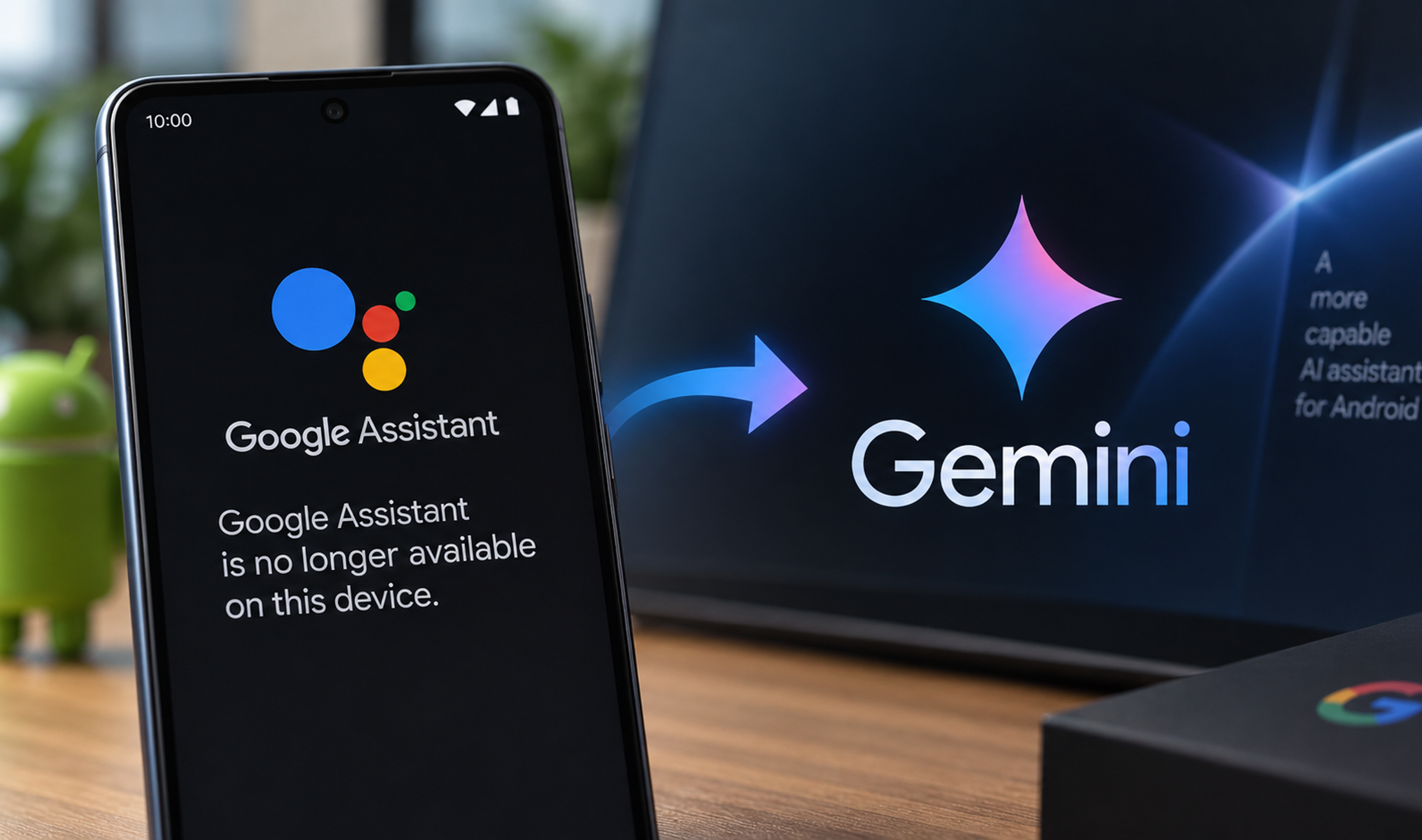
Google Assistant is reaching the end of the road on most Android phones and tablets. Starting September 4, 2026, Google says most users will no longer be able to use or switch back to the classic Google Assistant on eligible mobile devices. Gemini becomes the default Google assistant experience instead.
This is not simply an app rebrand. The change affects how Android users trigger voice help, ask follow-up questions, control connected services and interact with AI across Google apps. It also extends to some devices paired with a phone, including compatible Wear OS watches, headphones and earbuds, and Android Auto experiences.
Is Google Assistant shutting down today?
Yes, but the important detail is that Google describes September 4 as the point when most users will lose access on phones and tablets. That wording leaves room for a staged transition rather than a simultaneous global switch at one exact moment.
Google originally announced in March 2025 that the mobile Assistant experience would be upgraded to Gemini. The company later extended the migration into 2026 and updated its support notice to say that most users would no longer be able to use or return to Google Assistant from September 4, 2026.
What changes when Gemini replaces Google Assistant
The biggest change is the type of assistant Android users get. Google Assistant was built primarily around voice commands, information lookups and predefined device actions. Gemini is designed as a conversational AI assistant that can reason across longer requests, work with images and files, understand what is on the screen and connect with a growing range of Google services.

Common actions such as timers, calls, reminders, music playback and many hands-free tasks have been added to Gemini over time because these were essential Google Assistant functions. Gemini also adds capabilities that the classic Assistant was not designed for, including Gemini Live conversations, more open-ended planning, multimodal questions and deeper AI assistance.
The transition fits a much broader shift in Android. Google has been adding Gemini-powered features throughout the operating system, including the new September Android features that bring Gemini memory, Motion Assist and Guided Vision to supported devices.
Which Android phones can use Gemini?
Google's current Gemini mobile requirements say Android phones and tablets need at least 2GB of RAM and Android 9 or newer. Android Go devices are not supported by the Gemini mobile app.
That means many Android phones sold in India over the past several years meet the basic requirements. However, eligibility can still depend on account type, language, region, device software and whether the Gemini experience has been made available for that particular setup.
Google has also said that devices which do not meet Gemini's minimum requirements are an exception to the broad mobile shutdown. In other words, the September 4 change should not be interpreted as every old Android device instantly losing all Assistant functionality.
What Indian users should know about languages
Gemini is already available in India and supports several Indian languages, including Hindi, Bengali, Gujarati, Kannada, Malayalam, Marathi, Tamil, Telugu and Urdu, alongside English. This makes the transition more practical than it would have been when Gemini first launched.
Language support is not identical for every feature. Google notes that some supported Gemini languages do not support the 'Hey Google' wake phrase or every Gemini action. Users who rely heavily on voice control should therefore check whether their preferred language supports the specific hands-free features they use most often.
Will Hey Google still work?
On supported Android phones where Gemini is the mobile assistant, 'Hey Google' can still be used to invoke Gemini when voice activation is enabled. Touch shortcuts such as long-pressing the power button or swiping from a corner can also open Gemini on compatible devices.
The important distinction is that the familiar trigger may remain while the assistant behind it changes. A user can say the same wake phrase but receive a Gemini response, including more conversational answers and AI-generated help, rather than the classic Google Assistant interface.
What happens to watches, earbuds and Android Auto?
Google says the mobile transition also affects peripherals paired with the phone. That includes compatible Wear OS watches, headphones or earbuds that work with Gemini, and vehicles using Android Auto through the connected phone.
The exact experience can vary because Google has been moving different device categories to Gemini on different schedules. A paired accessory may rely on the phone's assistant, while other products have their own Assistant or Gemini implementation. Smart speakers and displays are also moving toward Gemini for Home, but they are part of a separate transition rather than simply the September 4 mobile cutoff.
Can you switch back to Google Assistant?
For users included in the September 4 transition, Google's updated notice says they will no longer be able to use or switch back to Google Assistant on the affected phone or tablet. That is the key difference from the earlier migration period, when some users could try Gemini and later revert to Assistant.
If Google Assistant still appears as an option on your phone today, that does not necessarily mean the retirement has been cancelled. The change may reach accounts and devices in stages, and Google's own wording focuses on 'most users' rather than every user.
What Gemini does better than Google Assistant
Gemini's strongest advantage is flexibility. It can handle more natural multi-part questions, discuss a topic over several turns, interpret images, reason about information on screen and help draft or transform content. Google is increasingly connecting it with Gmail, Maps, YouTube and other services, making it more useful for tasks that involve context rather than a single command.
This also explains why new Android flagships are being marketed around AI capabilities rather than only hardware. Headline Thread's Pixel 11 vs Pixel 11 Pro comparison looks at how Google's newer phones increasingly use Gemini and on-device AI as part of the buying decision.
What could be worse for some users
The trade-off is that an AI assistant can behave less predictably than a command-based one. People who used Google Assistant almost entirely for repeatable routines such as switching lights, starting music, making calls or controlling the phone may care more about speed and consistency than conversational intelligence.
Google has spent the transition period filling feature gaps, but users should still test the actions they rely on most. Work and school accounts can also have different Gemini access rules, and the Gemini app is not available inside Android Work Profiles.
How to check if your phone has moved to Gemini
Try the assistant shortcut you normally use, such as saying 'Hey Google' or long-pressing the power button. If Gemini opens, the migration is already active on your device. You can also open the Gemini app and review its settings, language and connected apps.
If your phone is eligible but Gemini is missing, update Google apps and Android system components through official channels. Avoid downloading unofficial APK files that claim to restore Google Assistant or unlock Gemini features. Headline Thread recently covered why malicious APK files are a growing risk for Android users.
Should you do anything before Google Assistant disappears?
Most users do not need to manually migrate data just to use Gemini. The practical step is to test the tasks you use every day: alarms, reminders, calls, messages, navigation, smart-home controls, music and routines. If a critical command behaves differently, check Gemini's settings and connected-app permissions before assuming the feature has been removed.
Privacy-conscious users should also review what data Gemini can access. An AI assistant becomes more useful when connected to personal services, but those integrations are optional and should match the level of access you are comfortable granting.
What happens next
September 4 is a milestone rather than the end of Google's assistant transition. Gemini is spreading beyond phones into watches, cars, smart-home devices and other Android hardware, while new Android features are increasingly being designed around AI from the start.
For Indian Android users, the immediate change is simple: on most eligible phones and tablets, Google Assistant is no longer the assistant Google wants users to return to. Gemini is now the main path forward. The larger question is whether Google's AI assistant can match the reliability of classic Assistant for routine voice commands while delivering enough extra intelligence to make the switch worthwhile.