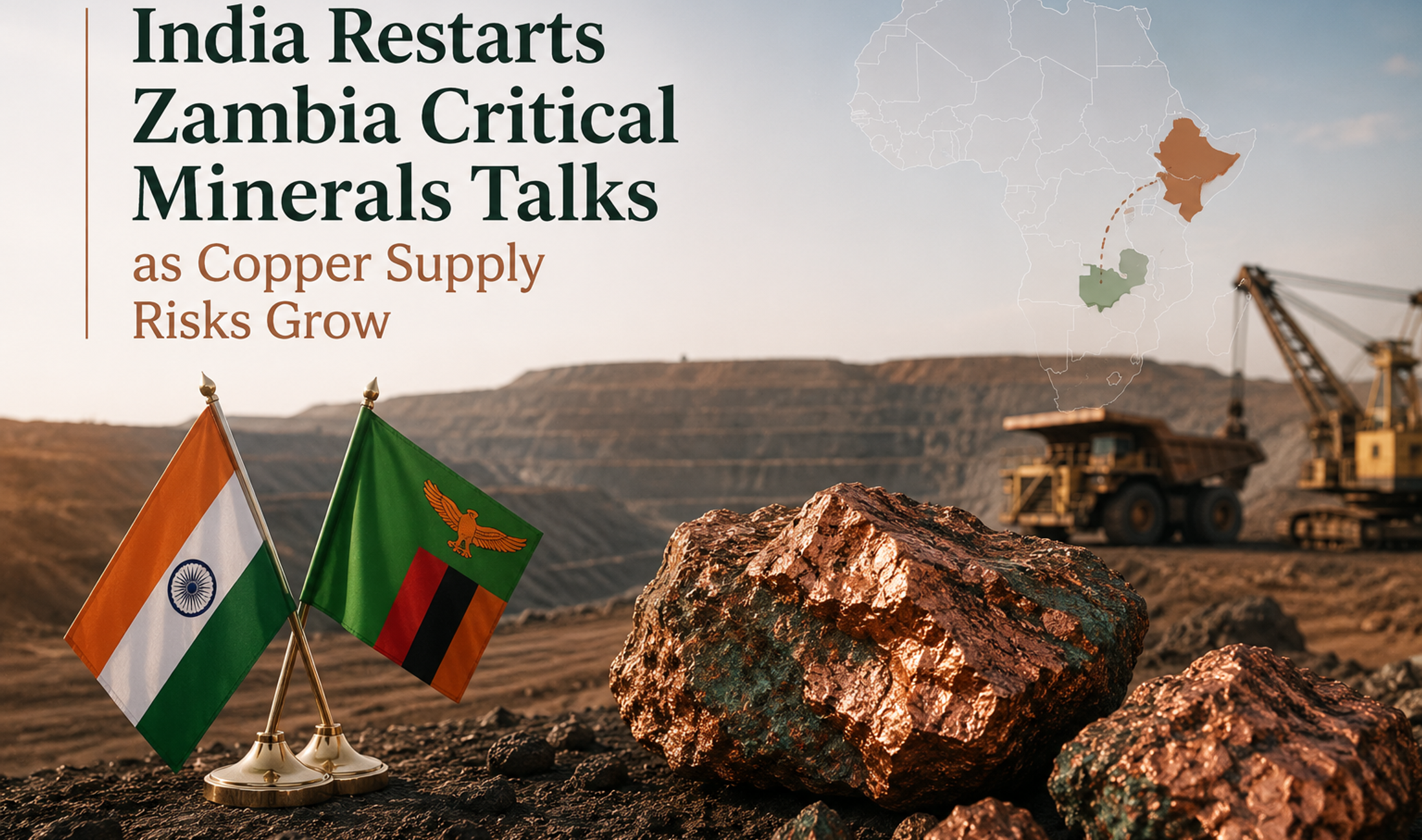
India has restarted discussions with Zambia over potential investments in copper and other critical minerals, reviving a strategic relationship that could become increasingly important as New Delhi tries to secure the raw materials needed for power grids, electric vehicles, electronics, renewable energy and industrial expansion.
Officials from India’s Ministry of Mines held preliminary talks with Zambian counterparts on August 26, according to Reuters. The discussions come several months after a separate India-Zambia mineral project stalled because New Delhi had not received the assurances it wanted over future mining rights for a roughly 9,000-square-kilometre exploration area.
The latest talks do not mean a mining deal has been signed. Reuters reported that the previously stalled project was not discussed in the August meeting, and Zambia’s Ministry of Mines said it could not confirm details of the new discussions. But the restart matters because India’s demand for copper and other strategic materials is growing faster than its ability to source many of them domestically.
Why India is looking to Zambia for critical minerals
Zambia is one of Africa’s most important copper producers and sits in the Central African Copperbelt, a region that also extends into the Democratic Republic of Congo. Copper is essential for electrical wiring, transmission networks, renewable-energy infrastructure, electric vehicles, data centres, industrial equipment and consumer electronics.
Zambia produced about 890,000 tonnes of copper in 2025 and has set an ambitious target of reaching 3 million tonnes a year by 2031. Its government says expanding exploration, mining, processing and investment will be necessary to reach that goal. The country also has resources of cobalt, nickel, manganese, lithium and rare-earth elements, giving it strategic relevance beyond copper alone.
For India, Zambia offers something that is difficult to create quickly at home: access to an established mining jurisdiction with large geological resources and the possibility of securing long-term supply through investment, mining rights or offtake agreements.
India’s copper dependence is becoming a strategic issue
India is already one of the world’s biggest buyers of refined copper. Imports increased sharply after the 2018 closure of Vedanta’s Sterlite Copper smelter in Tamil Nadu, which had been a major source of domestic refined copper output.
The longer-term pressure is even more significant. Government-linked estimates cited by Reuters suggest India may need to import between 91% and 97% of the copper concentrates it consumes by 2047 unless domestic mining and supply arrangements expand substantially.
Copper demand is not driven by one sector. Expanding electricity networks require large quantities of conductive metal. Electric vehicles use significantly more copper than conventional internal-combustion vehicles. Solar and wind projects need cables and grid connections, while factories, railways, telecommunications infrastructure and data centres all add to demand.
That makes overseas mineral security closely connected to India’s industrial strategy. The country is already trying to expand domestic electronics and semiconductor manufacturing through initiatives such as its semiconductor ecosystem push, while manufacturing programmes are also attempting to deepen local supply chains for phones and electronics.
What happened to the earlier India-Zambia project
India and Zambia had already been discussing a more direct exploration arrangement. Reuters reported in April that Zambia had allocated India access to an area covering about 9,000 square kilometres for exploration of copper and cobalt. An Indian team carried out geological work and returned with mineral samples.
The plan envisaged a multi-year exploration programme followed by possible private-sector participation. Talks then stalled because India wanted clearer assurances that successful exploration could ultimately lead to mining rights. Without that certainty, funding a lengthy exploration programme would create the risk of proving a resource without securing the ability to develop it.
The August 26 discussions appear to be a fresh track rather than a resolution of that dispute. That could give both sides more flexibility. India may explore direct investment in existing or near-production assets, long-term supply contracts or new government-to-government arrangements instead of relying on a single exploration block.
KABIL is looking far beyond Zambia
Khanij Bidesh India Ltd, or KABIL, is central to India’s overseas mineral strategy. The state-backed company was created to identify, acquire and develop critical mineral assets abroad so that Indian industry is less exposed to supply disruptions or excessive dependence on a small number of countries.
Reuters reported that KABIL is evaluating investment opportunities in Australia, Brazil, Canada, Russia and Indonesia and is discussing a project in Malawi. India has also been pursuing mineral partnerships across Africa and Latin America.
This diversified approach is important because critical-mineral supply chains can be geographically concentrated. India’s National Critical Mineral Mission notes that many strategically important minerals are concentrated in a limited number of countries and that refining capacity is often even more concentrated than mining.
How the National Critical Mineral Mission fits in
The Union government approved the National Critical Mineral Mission in January 2025 to build a more resilient supply chain from exploration and mining through processing, recycling and overseas acquisition. The mission covers 24 critical minerals and explicitly includes acquiring mineral assets outside India as one of its core measures.
The Geological Survey of India was tasked with conducting 1,200 exploration projects between 2024-25 and 2030-31. The government has also auctioned critical-mineral blocks, introduced recycling incentives and funded research into recovering valuable minerals from tailings, industrial waste and other secondary sources.
Domestic exploration can reduce dependence over time, but it cannot instantly replace imports. This is why overseas sourcing sits alongside India’s broader efforts to build local manufacturing, including the mobile manufacturing expansion and other programmes that increase demand for metals and advanced materials.
Why copper security matters even outside electric vehicles
Copper is sometimes discussed mainly as an electric-vehicle metal, but India’s power system may be the larger strategic reason to secure supply. Transmission lines, substations, transformers, renewable-energy projects, charging infrastructure and industrial electrification all depend on copper.
India is simultaneously planning major additions to nuclear, solar and other generation capacity. Recent changes to India’s nuclear-power framework illustrate how aggressively the country is trying to expand future electricity supply. Generating more power also requires strengthening the grid that carries it, which increases demand for conductive materials.
Data centres and AI infrastructure add another source of demand. Large computing facilities require extensive power connections, backup systems, cooling infrastructure and internal electrical distribution. As India attracts more cloud and AI investment, the country’s appetite for copper, aluminium and other infrastructure materials could rise further.
What a successful Zambia partnership could look like
A successful agreement does not necessarily require India to own a mine outright. Indian companies could take minority stakes in existing projects, finance expansions in exchange for supply, sign long-term offtake agreements, form joint ventures with Zambian companies or participate in new exploration areas where mining rights are clearly defined.
Industry representatives cited by Reuters argued that Indian companies should prioritise brownfield and near-production projects combined with long-term offtake agreements. That approach can reduce the long delays and geological risk associated with starting a mine from scratch.
Zambia also has incentives to attract more capital. Its 3-million-tonne copper strategy depends on investment in exploration, mines, processing capacity, infrastructure and technology. A long-term Indian buyer could offer financing and demand certainty while Zambia seeks to expand production.
What happens next
The immediate development to watch is whether the preliminary talks produce a formal government-to-government framework, a KABIL investment proposal or direct negotiations involving Indian private-sector miners and metal companies.
The unresolved question over mining rights from the earlier 9,000-square-kilometre project will also matter. If the two governments can establish a structure that gives investors confidence over exploration, development and long-term supply, Zambia could become a meaningful part of India’s overseas mineral portfolio.
For India, the larger lesson is that critical-mineral security cannot be solved by domestic mining alone. The country is trying to build batteries, electronics, power infrastructure and advanced manufacturing at the same time that global competition for copper, cobalt, lithium, nickel and rare earths is intensifying. Securing diversified overseas supply before shortages become acute is therefore increasingly an industrial-policy issue rather than simply a mining-sector decision.
The renewed Zambia talks are still at an early stage, but they show the direction of travel: India is moving from identifying critical minerals as a vulnerability to actively negotiating for access to the resources that its next phase of growth will require.