
India’s Unified Payments Interface has completed a decade of operation, marking 10 years since its August 25, 2016 launch. What began as a new way to move money between bank accounts has become the default payment layer for millions of Indians, from a ₹20 tea purchase to rent, shopping and transfers between family members.
The scale of that change is unusually large. According to the Ministry of Finance’s 10-year UPI review, annual transaction volume grew from 1.78 crore transactions in FY2016-17 to more than 24,162 crore in FY2025-26, an increase of almost 13,000 times. Annual transaction value rose from ₹0.07 lakh crore to roughly ₹314 lakh crore over the same period.
The anniversary matters for more than the headline numbers. UPI changed the economics of accepting digital payments for small merchants, made instant bank-to-bank transfers routine, and gave India a payments infrastructure that is increasingly being connected to overseas markets. As UPI enters its second decade, the more important question is how much further the system can expand without losing the simplicity and reliability that made it successful.
UPI’s Growth in Numbers
The latest NPCI product statistics show how quickly the platform is still growing even after reaching enormous scale. In July 2026, UPI processed 23,658.35 million transactions worth ₹29,87,880.49 crore. There were 741 banks live on the platform.
That July volume works out to more than 23.6 billion transactions in a single month. The government says UPI now handles an average of around 66 crore transactions a day and accounted for 84% of India’s digital payment transactions in FY2025-26.
The growth is not simply the result of more people using smartphones. UPI removed several pieces of friction that previously made digital transfers cumbersome. Users can pay across participating banks and apps without needing to know detailed bank information for every transaction, while merchants can accept payments through inexpensive QR codes instead of relying on card terminals.
How UPI Changed Everyday Payments in India
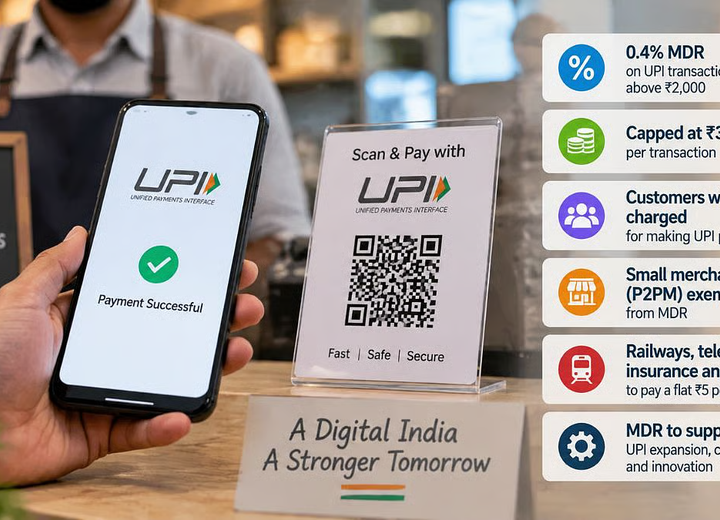
The most visible sign of UPI’s impact is the QR code. Digital acceptance no longer requires a large retailer, a point-of-sale terminal or a card network at the checkout counter. A street vendor, taxi driver, neighbourhood shop or small restaurant can accept a bank payment using a printed code and a compatible account.

Government data shows that person-to-merchant payments now account for 63% of UPI transaction volume. In FY2025-26, 86% of merchant transactions were below ₹500. Those numbers explain why UPI feels less like a specialist banking product and more like everyday infrastructure: its biggest use case by count is frequent, low-value spending.
Person-to-person transfers remain important in a different way. They account for a larger share of transaction value, reflecting uses such as sending money to family, splitting expenses and moving larger amounts directly between bank accounts.
Why UPI Became So Important for Small Merchants
For small businesses, one of UPI’s biggest advantages has been reducing the practical barrier to accepting digital money. A merchant can display a QR code without investing in the hardware traditionally associated with card acceptance. Customers can pay using different participating apps while the money settles through the interoperable UPI system.
That interoperability is critical. India did not end up with a payment market where a customer and merchant necessarily need the same wallet provider. UPI instead functions as common infrastructure connecting banks and payment apps, which makes acceptance more useful as the network grows.
There are also broader effects. Digital transaction records can make business cash flow easier to track, while instant confirmation reduces some of the inconvenience associated with cash handling. At the same time, merchants still depend on reliable connectivity, banking systems and fraud controls, so continued scale brings operational challenges as well as benefits.
UPI Is No Longer Only an Indian Payment System
The next stage of UPI’s story is increasingly international. The Finance Ministry says UPI is operational in 11 countries: the United Arab Emirates, France, Bhutan, Sri Lanka, Nepal, Singapore, Mauritius, Qatar, Cambodia, Greece and the Maldives.
The government also says UPI accounted for nearly 49% of global real-time payment transaction volume as of 2025. That does not mean every overseas market uses UPI in the same way India does. International deployments can involve merchant acceptance, payment linkages or arrangements designed to make cross-border transactions easier.
For Indian travellers, wider merchant acceptance can eventually reduce dependence on cash and international cards in supported locations. For India, the larger strategic value is demonstrating that domestic digital public infrastructure can become exportable or interoperable beyond its home market.
What Comes Next for UPI
UPI’s second decade will be less about proving that Indians are willing to scan QR codes and more about improving what can happen around the payment itself. The ecosystem has already expanded beyond basic person-to-person transfers, and newer capabilities are aimed at delegated payments, international acceptance and more flexible payment experiences.
One example is UPI Circle, which allows a primary user to authorize another person to make UPI payments under defined arrangements. Features like this can broaden access for family members or users who do not manage every payment directly themselves.
Reliability will become even more important as transaction volumes rise. When a payment rail handles tens of billions of transactions each month, even a small percentage of failures can affect a large number of people. Banks, apps and NPCI therefore have to keep improving capacity, dispute handling, fraud detection and user education alongside new features.
The Challenges UPI Still Has to Solve
Success at UPI’s scale creates its own problems. Fraudsters frequently exploit users through social engineering, fake payment requests and impersonation even when the underlying payment infrastructure is secure. The distinction matters because many scams do not require attackers to break UPI itself; they convince a user to approve something they should not.
The ecosystem also has to balance low-cost payments with sustainable economics for banks, payment apps and other participants. UPI’s broad adoption has been helped by its accessibility, so any changes affecting the cost or experience of routine payments attract intense attention.
Finally, access remains uneven. Smartphone availability, digital literacy, connectivity and confidence with online banking still vary across users and regions. UPI has narrowed some barriers to digital payments, but reaching the next group of users will require more than simply processing a larger number of transactions.
What UPI’s First Decade Means for India
UPI’s most important achievement is not that India can point to a very large transaction number. It is that instant digital payment became ordinary. Paying a small merchant electronically no longer feels like a premium service, and sending money directly from a bank account can take seconds rather than requiring a separate wallet balance or lengthy transfer process.
That behavioural change has implications for commerce, financial inclusion and the way new financial products are built. UPI provides a common payment layer on top of which banks and technology companies can compete on user experience rather than each trying to create an isolated acceptance network.
The milestone also fits a wider shift in India’s financial infrastructure. Headline Thread has recently examined India’s planned first tokenised corporate bond pilot and changes to India’s FDI rules. UPI’s decade of growth shows how quickly infrastructure can become economically significant when it is interoperable, widely accessible and useful for everyday transactions.
The Bottom Line
Ten years after launch, UPI has moved from an experiment in instant bank payments to core infrastructure for India’s economy. July 2026 alone saw more than 23.6 billion transactions, while annual volumes have increased almost 13,000-fold since the platform’s first financial year.
The next decade will test whether UPI can maintain reliability and trust at still greater scale, deepen access for users who remain outside digital payments, and turn its international expansion into genuinely useful cross-border payment connections. The first decade was about adoption. The second will be about making that scale more capable, resilient and global.