India has changed the legal framework around UPI fees, but that does not mean every payment above ₹2,000 suddenly carries a charge. A Finance Ministry notification dated September 14 protects UPI transactions up to ₹2,000 from direct or indirect charges by banks and payment system providers. The same protection applies to RuPay debit card payments.
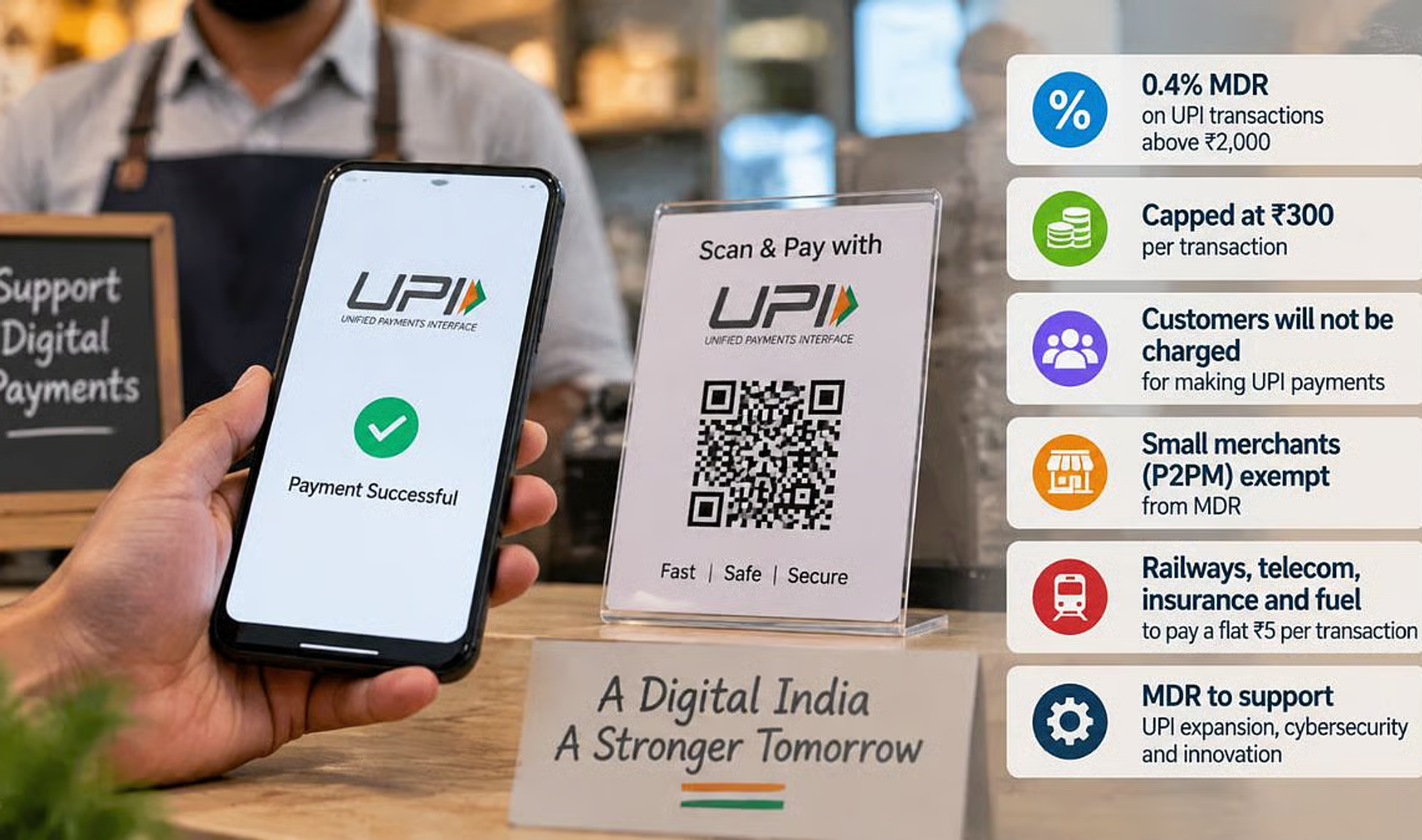
The important change is what happens beyond that threshold. The revised framework creates room for a Merchant Discount Rate, or MDR, on certain higher-value merchant payments. The government has not announced a blanket fee on consumers, and person-to-person UPI transfers remain free.
What has the government actually announced?
The notification was issued under Section 10A of the Payment and Settlement Systems Act, 2007. It specifies RuPay-powered debit cards and UPI transactions up to ₹2,000 as electronic payment modes on which a bank or system provider cannot impose a charge on the person making or receiving the payment.
This is narrower than the previous zero-charge framework that effectively covered UPI payments more broadly. The amendment therefore matters because payments above ₹2,000 are no longer covered by the same statutory protection, allowing policymakers to design a fee structure for selected transactions if they choose to do so.
Will you pay a fee when sending more than ₹2,000 by UPI?
Not simply because the amount exceeds ₹2,000. The key distinction is between a person-to-person transfer and a payment to a merchant. The government has said person-to-person UPI transfers will remain free. The policy discussion is focused on an MDR for selected merchant transactions above the threshold.
So if you send ₹5,000 to a friend or family member through UPI, the current policy does not turn that transfer into a paid transaction. If you pay ₹5,000 to a business, however, that payment could eventually fall within a merchant-fee regime if the government introduces one for that category.
Is a 0.4% UPI fee confirmed?
No final 0.4% charge has been announced. Reuters reported on September 15 that India's payments authority is consulting banks and payment companies about possible charges on merchant UPI transactions above ₹2,000, with a fee of around 0.4% among the options being discussed. The consultation is not the same as a final rule.
That distinction matters because reports describing a ₹2,000-plus UPI fee as already active can give users the wrong impression. The legal door is open and industry discussions are underway, but the final rate, eligible merchant categories, implementation date and revenue-sharing formula can still change.
Why is India considering MDR on UPI?
UPI has grown into the default payment method for millions of Indians, but processing that enormous volume requires banks, payment apps, aggregators and infrastructure providers to keep investing in technology, fraud prevention, reliability and customer support.
Reuters reported that UPI processed about 24 billion payments worth roughly $311 billion in August 2026 alone. A fee on a relatively small share of larger merchant transactions could create a revenue stream for the payments ecosystem without putting a charge on routine low-value payments.
Government-backed reporting says around 96% of UPI transactions by volume fall within the protected ₹2,000 band. That means the threshold is designed to keep the overwhelming majority of everyday transactions covered by the zero-charge rule even if a merchant MDR is introduced above it.
Could merchants pass the fee on to customers?
That will depend on the final rules. MDR is traditionally a merchant-side cost paid for accepting a digital payment rather than a fee charged directly to the customer. The government has specifically said consumers will not be charged for making UPI payments, but the final framework will need to make clear how merchant charges are enforced and whether businesses can recover those costs in other ways.
What this means for PhonePe, Google Pay and Paytm
A merchant-fee model could materially change the economics of India's payments industry. UPI apps have spent years handling huge payment volumes while the core UPI rail remained largely free. A carefully designed MDR could provide more revenue to banks, apps and payment aggregators, although the way that revenue is divided is still under discussion.
For users, the more immediate story is how quickly UPI keeps expanding into new payment experiences. Headline Thread recently explained how UPI Tap & Pay uses NFC for contactless payments and how WhatsApp bill payments work in India. The fee debate now determines how that increasingly important infrastructure will be funded.
What should UPI users do now?
There is no reason to stop using UPI or split ordinary payments simply because they cross ₹2,000. Transactions up to ₹2,000 are explicitly protected from charges, person-to-person transfers remain free, and a fee on larger merchant payments has not yet been finalised.
The next development to watch is a formal decision on MDR for merchant payments above ₹2,000. Until the government or payments authority publishes the final rate and implementation rules, claims that all UPI payments above ₹2,000 now attract a fee should be treated as inaccurate.