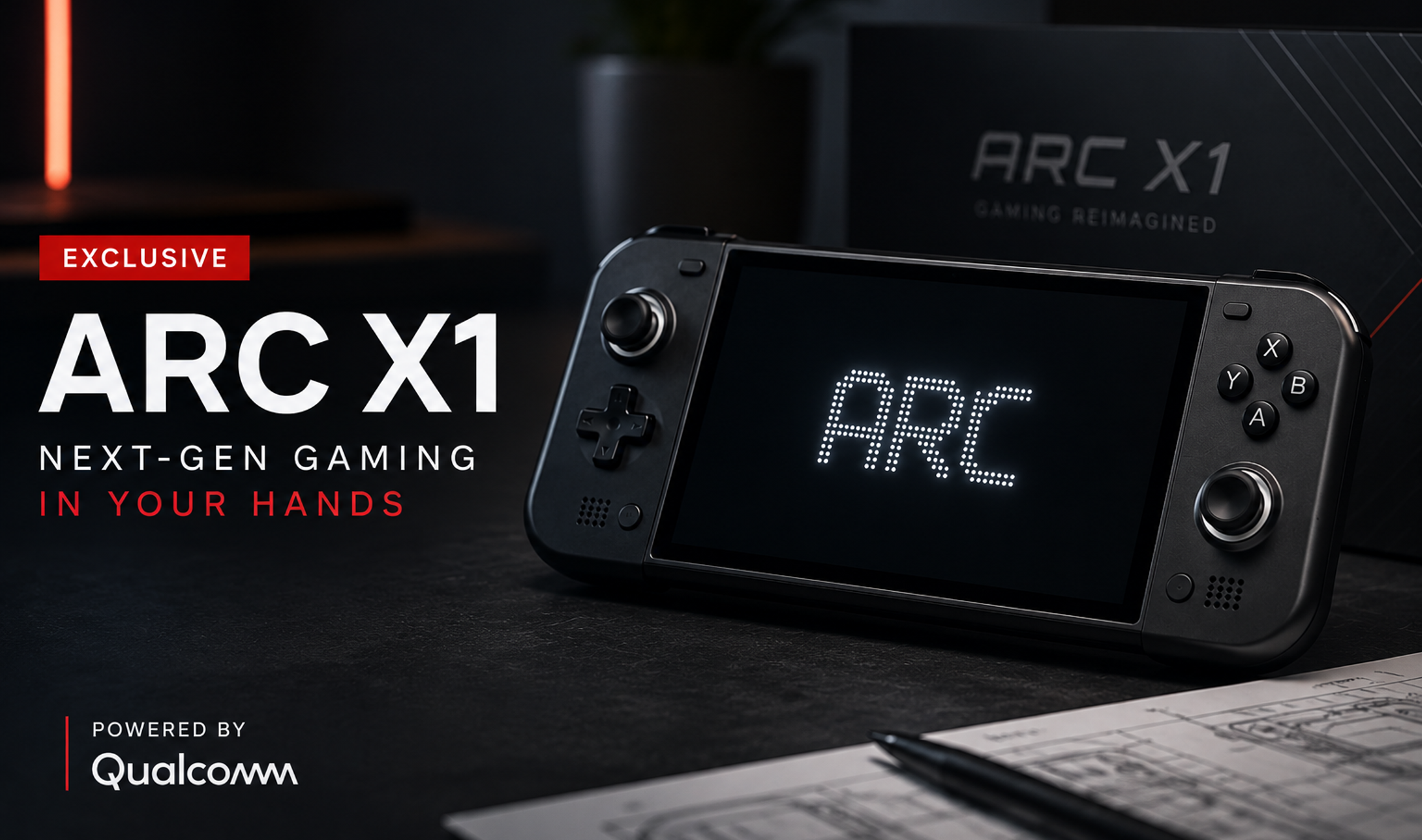
India’s handheld gaming market is still small compared with smartphones and consoles, but an Indian startup is trying to build a device specifically around local buying realities. ARC has announced a strategic partnership with Qualcomm Technologies to develop the ARC X1 handheld gaming device and a broader lineup of gaming hardware aimed at India and other emerging markets.
The announcement matters because ARC is not simply importing an existing handheld and rebadging it. The company says the X1 is being built around performance-per-watt, battery life, low-latency connectivity and a custom Android-based operating system called OwlOS. Qualcomm’s role covers compute, AI and wireless connectivity, but the exact processor has not yet been disclosed.
What ARC and Qualcomm have confirmed
ARC says it is working with Qualcomm to design and build a new generation of high-performance gaming devices, beginning with the X1. Publicly available information points to four priorities: stronger compute capability for modern game engines and cross-platform titles, a power-optimised system architecture, low-latency networking for cloud and competitive multiplayer gaming, and a lightweight form factor designed for portable everyday use.
The company has not confirmed whether the X1 will use a Snapdragon smartphone processor or one of Qualcomm’s Snapdragon G-series chips created specifically for gaming handhelds. That is an important distinction because the chipset will influence graphics performance, power efficiency, thermal behaviour, emulation capability and ultimately the price ARC can target.
Why performance-per-watt matters more than raw benchmark numbers
ARC co-founder Jobin Joseph has framed performance-per-watt as a core requirement for markets such as India. That is a sensible design goal for a handheld. A processor that can produce very high peak performance for a short burst is less useful if the device becomes uncomfortable to hold, throttles after sustained play or drains the battery quickly.
The challenge is therefore different from building a desktop gaming PC. A handheld has to balance GPU performance, CPU load, display power, memory bandwidth, thermal limits, fan noise, battery capacity and weight. If ARC can tune the X1 around sustained performance rather than marketing-friendly peak numbers, it could be better suited to long gaming sessions and cloud gaming on Indian mobile networks.
What Qualcomm is bringing to the ARC X1
Qualcomm’s involvement gives ARC access to more than a processor. Modern Snapdragon platforms combine CPU and GPU hardware with AI acceleration, video processing, Wi-Fi and Bluetooth technologies, power-management systems and developer tools. ARC says the collaboration will focus on computing, artificial intelligence and wireless connectivity.
For a gaming handheld, the wireless side is especially important. Cloud gaming and multiplayer titles are sensitive to latency and connection stability, while Bluetooth is commonly used for headsets, controllers and accessories. ARC has specifically highlighted low-latency networking as part of its design direction, although it has not yet published final Wi-Fi, Bluetooth or cellular specifications.
OwlOS could be the most important part of the product
The X1 will not run a stock Android interface. ARC is developing OwlOS, its own Android-based operating system, with a controller-first interface and system-level gaming optimisations. ARC describes OwlOS as an operating system built around portable gaming rather than Android simply placed inside gaming hardware.
That distinction can make or break the experience. Android gives ARC access to a large software ecosystem, but conventional Android interfaces are designed around touch. A handheld needs menus, game libraries, settings, storefronts, updates and power controls that can be comfortably navigated with sticks and buttons from the moment the device boots.
This is also one of the clearest ways the X1 may differ from Windows-based handheld PCs. Microsoft continues to evolve the broader PC platform, including the upcoming Windows 11 26H2 update, but Windows remains a general desktop operating system first. ARC is trying to make OwlOS feel purpose-built for a portable console-style device.
Can it run more than ordinary Android games?
ARC says the X1 is being optimised for modern game engines and multi-platform titles, and its public material positions OwlOS as a more unified gaming layer. However, the company has not published a complete compatibility list, supported game stores or details on how PC or console-class games would be delivered.
ARC’s site has shown Hades II gameplay running at 60 frames per second on a device using OwlOS, according to reporting that references the company’s official material. That is encouraging, but it should not be interpreted as a final performance guarantee for the retail X1 until ARC identifies the hardware, software build, resolution and test conditions.
Why an India-focused handheld could have a real opening
Most premium handheld gaming PCs are designed primarily for North America, Europe, China or Japan and reach Indian buyers through limited retail channels at relatively high prices. That creates room for a product designed around Indian pricing, local distribution, service support and common connectivity conditions.
The opportunity is not simply to make a cheaper device. ARC has to find a useful middle ground between low-cost Android retro handhelds and expensive Windows gaming PCs. The X1 will need enough graphics capability for modern games, a good display, responsive controls, dependable thermals and battery life that feels meaningfully better than gaming on a phone with a controller attachment.
India’s gaming hardware audience is also becoming more comfortable with specialist products. Headline Thread recently covered Samsung’s new Odyssey gaming monitor lineup, including high-refresh-rate displays built for demanding PC gamers. The X1 targets a different use case, but both launches point to a broader market for dedicated gaming hardware beyond phones and traditional consoles.
What ARC has not announced yet
The biggest buying questions are still unanswered. ARC has not announced the final Snapdragon chipset, RAM, storage, display size, resolution, refresh rate, battery capacity, charging speed, weight, dimensions, port selection or final controller layout. It has also not confirmed pricing or a retail launch date.
Those missing details are not minor. A handheld can look compelling in concept but become difficult to recommend if the display is weak, the controls are cramped, the storage is too small, thermals are poor or the price moves too close to established global alternatives. ARC says more details will be shared in the coming months, and its official waitlist remains open.
Who should be interested in the ARC X1?
The X1 is worth watching if you want a dedicated handheld but find current Windows gaming PCs too expensive, too heavy or too power-hungry. It may also appeal to Android gamers who want physical controls, better sustained performance and a console-like interface without building a setup around a smartphone and clip-on controller.
Cloud-gaming users could also benefit if ARC delivers on its low-latency networking focus. A lighter device with efficient hardware does not need desktop-class local performance for every title if part of the experience comes from streaming. That approach could make sense in homes with strong broadband or 5G, but service availability, subscription costs and network quality will still matter.
Who should wait before getting excited?
Anyone choosing between the X1 and an established handheld should wait for final specifications and independent testing. ARC is still developing the product, and there is currently no verified India price or sale date. The partnership with Qualcomm improves the credibility of the hardware plan, but it does not yet tell buyers whether the X1 will be competitive at retail.
Game compatibility deserves particular scrutiny. Buyers should wait for a clear list of supported stores, native games, cloud services, emulation policies and update commitments. A polished interface is valuable only if the titles people actually want to play are easy to install and run.
What happens next
ARC says it will reveal more information about the X1 and future handhelds over the coming months. The next meaningful milestones are the processor announcement, final industrial design, display and battery specifications, supported game ecosystem, India price and launch timeline.
For now, the Qualcomm partnership is the strongest signal yet that ARC wants to build the X1 as a serious gaming platform rather than a novelty Android handheld. Whether it succeeds will depend less on headline specifications and more on execution: sustained performance, software polish, game compatibility, battery life, service support and a price Indian gamers can actually justify.