Philips is returning to India’s smartphone market with the S7221 5G, a budget-to-mid-range Android phone scheduled to launch on September 2, 2026. The device has already appeared on an Amazon India microsite, which confirms several core specifications and gives buyers a fairly clear idea of what Philips is trying to offer.
The most important detail at the time of writing is also the one Philips has not yet revealed: the official India price. That means buyers should treat any price circulating before the launch announcement as an estimate rather than a confirmed figure.
What is confirmed is that the S7221 will support 5G, offer a 120Hz display, a 64-megapixel rear camera, a 16-megapixel selfie camera, up to 8GB RAM and up to 256GB storage. It will be sold through Amazon India. Those specifications put it directly into one of the country’s most competitive smartphone segments, where recent launches such as the Poco X8 series are competing heavily on battery size, display quality and value.
Philips S7221 confirmed specifications
The Amazon teaser and current reporting confirm a 120Hz display, although Philips has not published the complete panel specification in its launch communication. That distinction matters because refresh rate tells only part of the display story. Buyers should still check the final resolution, panel type, peak brightness and whether the phone supports HDR before judging the screen against similarly priced rivals.
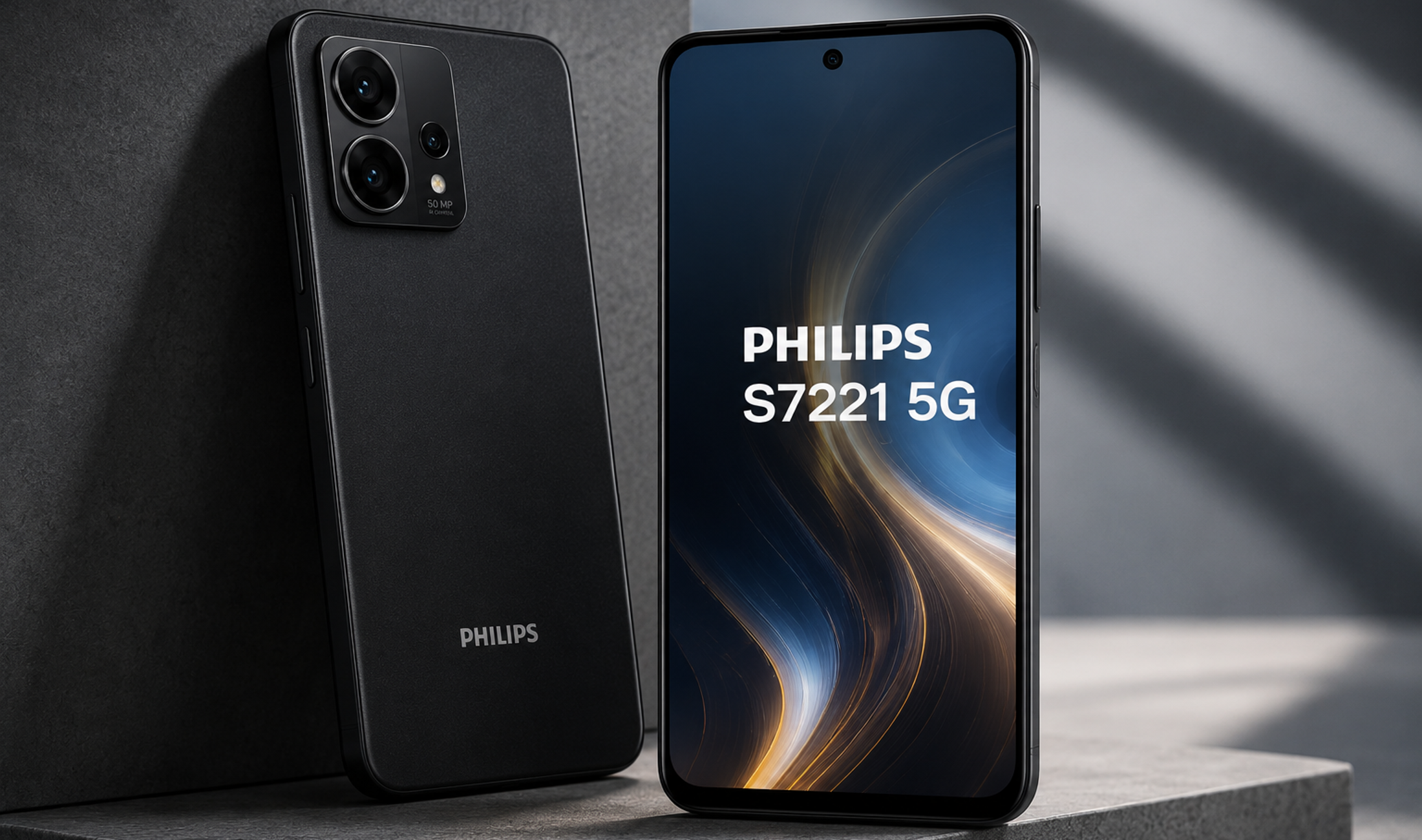
For photography, Philips is advertising a 64-megapixel AI-assisted main rear camera and a 16-megapixel front camera. Product images show a dual-camera arrangement on the back, but the purpose and resolution of the secondary rear sensor should be verified at launch. Philips has not yet published enough information to make a reliable claim about camera quality, low-light performance or video stabilisation.
The S7221 will be offered with 6GB or 8GB of RAM and 128GB or 256GB of storage. This gives Philips enough flexibility to create at least two meaningful price tiers. Buyers should still confirm whether the storage is expandable and which memory and storage standards are being used, because those details can affect app loading and overall responsiveness.
The phone is also confirmed to support dual stereo speakers with what Philips calls Ultra Max audio, along with an IP64 rating for dust and splash resistance. IP64 is useful for protection against dust and light splashes, but it should not be confused with the stronger water-resistance ratings seen on some higher-end phones.
Design and colours
The S7221 follows a familiar modern Android design. The front uses a flat display with a centred hole-punch camera, while the rear has a raised rectangular camera island in the upper-left corner. Two rear camera lenses are arranged vertically beside a circular flash.

Amazon promotional material shows black, silver or grey, and white finishes. Philips has not published final marketing names for all of the colours, so those should not be treated as official colourway names until the product page goes live.
Why Philips is returning now
Philips is a familiar electronics name in India, but it is not currently one of the major smartphone brands competing for market share. Entering the market in 2026 gives it an opportunity, but also creates a difficult challenge: Indian buyers already have strong choices from Samsung, Xiaomi, Poco, Realme, Vivo, Motorola, OnePlus, Nothing and several newer brands.
It is also arriving at a time when India is trying to deepen local electronics manufacturing. The government’s broader push to expand domestic phone production and supply chains, including the mobile manufacturing scheme, has made the Indian smartphone market strategically important not only for sales but also for manufacturing and sourcing.
The opportunity for Philips is therefore less about simply attaching a known brand name to a phone and more about whether it can deliver competitive pricing, dependable software support, a useful service network and consistent after-sales support.
The biggest unanswered questions are price and software support
Price will determine almost everything about the S7221’s position in India. A 120Hz display, 64MP camera and 8GB RAM sound competitive on paper, but similar headline specifications are now common across affordable 5G phones. Philips will need to price the handset against the actual strengths of its processor, display technology, battery, charging and software rather than relying on camera resolution alone.
The processor has not been sufficiently detailed in the launch material available at the time of writing. That is a major omission for buyers because chipset choice affects performance, gaming, efficiency, modem quality and long-term software viability. Until Philips confirms the exact chip, it is too early to judge how the S7221 will compare with phones using established MediaTek Dimensity or Qualcomm Snapdragon platforms in the same price range.
Software support is equally important. Philips has not yet provided a clear Android version commitment, number of major operating-system updates or length of security-patch support. Buyers planning to keep the phone for three or four years should wait for this information before deciding.
Battery and charging need close attention
Battery capacity and charging speed are now major selling points in India’s mid-range phone market. Some recent devices are pushing well beyond 7,000mAh, and manufacturers increasingly use battery size as a headline feature. Philips has not made battery capacity or charging speed central to the verified pre-launch material available for the S7221.
That means buyers should compare the final numbers carefully with new models such as the Redmi 17 5G, which has already been positioned heavily around its large battery. A phone with a good display and camera can still be a strong choice with a smaller battery, but the trade-off should be reflected in price, weight or charging speed.
Who should consider the Philips S7221
The S7221 could be worth considering for buyers who want a mainstream-looking 5G phone, value a high-refresh-rate screen, prefer stereo speakers and recognise Philips as an established electronics brand. The 6GB and 8GB RAM options also suggest that Philips intends to cover more than one affordable price point rather than sell a single fixed configuration.
It may also appeal to buyers who want something different from the usual Xiaomi, Samsung, Realme or Vivo choices. But brand familiarity in televisions, audio or appliances does not automatically translate into a strong smartphone experience. The software, update policy and service network matter just as much as the hardware list.
Who should wait before buying
Anyone prioritising gaming performance should wait for the exact chipset and sustained-performance details. Buyers focused on cameras should wait for real-world reviews rather than assuming that a 64MP sensor guarantees better results. People who keep phones for several years should also wait for a written software-support commitment.
The same applies to buyers choosing mainly on value. Without the official India price, it is impossible to determine whether the S7221 offers better value than established alternatives. A ₹2,000 or ₹3,000 difference can completely change the recommendation in this segment.
How the S7221 fits into India’s increasingly crowded 5G market
Philips is not the only brand trying to create a new position in India’s smartphone market. Mivi has also announced plans to enter the category, showing that established Indian electronics and accessory brands see room for new challengers despite intense competition.
Headline Thread recently covered Mivi’s upcoming first smartphone, another example of a familiar consumer brand trying to convert existing recognition into handset sales. Philips has an even older brand identity, but the same basic test applies: the phone must be competitive on its own merits.
The S7221’s confirmed combination of 5G, 120Hz display, 64MP camera, stereo speakers and IP64 protection gives Philips a credible starting point. The missing pieces are the ones that will decide whether it becomes a real recommendation: price, processor, battery, charging, software policy and service support.
What to watch at the India launch
The launch announcement should answer five questions: the exact starting price, the chipset, battery capacity and charging speed, Android version and update policy, and the date when sales begin on Amazon India.
Buyers should also check whether all RAM and storage variants are available from day one, whether the charger is included in the box, and how Philips plans to handle warranty repairs and service centres in India.
Until those details are confirmed, the S7221 looks interesting rather than automatically recommendable. Philips has already shown enough hardware to attract attention, but in India’s value-focused smartphone market, the final price and ownership experience will matter more than the return of a famous brand name.
This article will be most useful as a launch-day buying checklist: if Philips prices the S7221 aggressively and commits to reliable updates and support, it could become a credible new option. If those areas are weak, established rivals will remain difficult to beat even with a 120Hz display and 64MP camera.