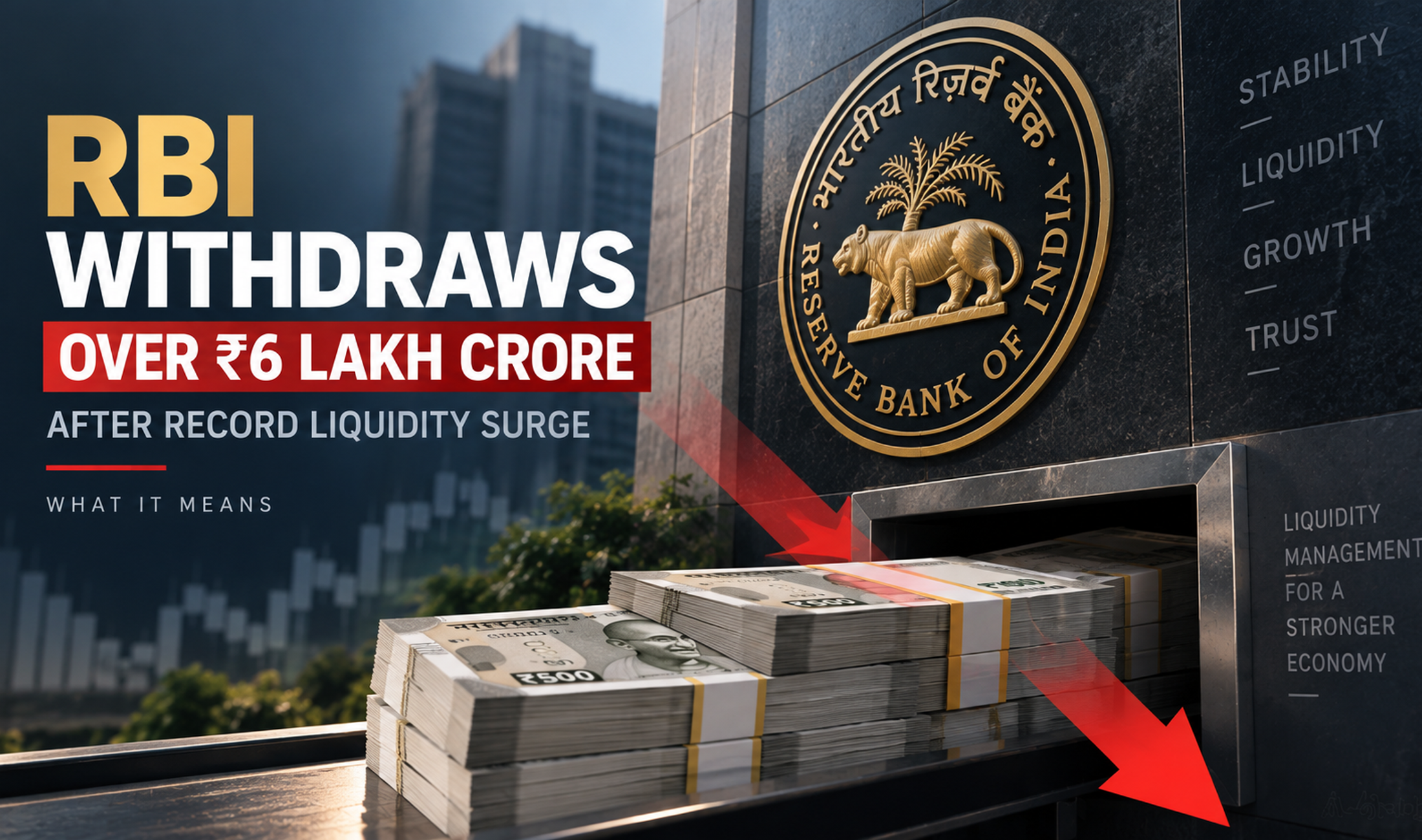
The Reserve Bank of India has pulled more than ₹6 lakh crore of excess cash out of the banking system after liquidity surged to an unprecedented level, turning what might sound like an obscure money-market operation into an important signal for borrowers, banks and investors.
On September 7, 2026, the central bank accepted about ₹3.53 lakh crore through an overnight variable-rate reverse repo auction and another ₹2.59 lakh crore through a 30-day operation, according to Reuters. Together, the two operations absorbed more than ₹6.1 lakh crore. The action followed a record liquidity surplus of roughly ₹11.6 lakh crore in the banking system.
Why is there so much extra money in the banking system?
The immediate backdrop is an unusually large wave of foreign-currency inflows. Headline Thread previously covered how $136 billion of inflows helped push the Indian rupee to a two-month high. When large foreign-currency inflows enter India and are converted into rupees, they can add domestic liquidity to the banking system.
That is useful up to a point. Comfortable liquidity allows banks to lend and helps money markets function smoothly. But an extreme surplus creates a different problem: short-term interest rates can fall below the level the RBI wants, weakening the transmission of monetary policy and potentially encouraging excessive risk-taking or credit growth.
What did the RBI actually do?
The RBI used variable-rate reverse repo operations. In simple terms, banks temporarily park surplus funds with the central bank and receive interest. This removes that cash from the immediately available pool without permanently taking money out of the financial system.
The overnight auction attracted about ₹3.53 lakh crore. A separate 30-day auction absorbed around ₹2.59 lakh crore, although the RBI had offered to take as much as ₹7 lakh crore in that longer operation. Reuters reported that some traders cited technical difficulties for the lower participation, while a source familiar with the central bank's systems denied that there had been a technical glitch.
The distinction matters because weak participation in a longer-tenor operation can also reflect banks' preference to keep cash flexible rather than lock it away for a month.
Does this mean the RBI is raising interest rates?
No. Liquidity management and a policy-rate decision are related but not the same thing. The RBI can absorb excess cash to keep overnight money-market rates aligned with its policy stance without changing the repo rate itself.
For households, that means this operation should not be read as an automatic signal that home-loan or fixed-deposit rates are about to jump. Its first-order impact is on liquidity available to banks and short-term market rates.
Why the RBI cannot simply leave the surplus alone
A sustained flood of liquidity can complicate inflation control. When banks have far more cash than they need, funding becomes unusually cheap and the central bank can lose some control over the interest rate at which overnight money changes hands. Economists cited by Reuters warned that a prolonged surplus could add inflationary and financial-market risks.
The balancing act is particularly important while India's economy is growing strongly. The RBI has to prevent surplus liquidity from undermining monetary control without unnecessarily tightening financial conditions for businesses and households.
What it means for the rupee and markets
The liquidity surge is closely connected to currency-market dynamics. On September 7, the rupee ended around ₹94.485 per US dollar, according to Reuters, with reported RBI intervention helping offset pressure from oil prices near six-week highs.
India also entered this period with substantial foreign-exchange buffers. Foreign-exchange reserves recently reached a record $729.3 billion, giving the central bank more room to manage disorderly currency moves than it would have with thinner reserves.
For bond and money-market investors, the more immediate question is how aggressively the RBI continues draining liquidity. Persistent absorption can support short-term rates, while the choice between overnight operations, longer reverse repos, market-stabilisation bonds and foreign-exchange swaps will determine how durable the drain becomes.
What happens next?
The September 7 operations are unlikely to be the end of the story if the banking system continues carrying a multi-lakh-crore surplus. Reuters reported that the RBI has already withdrawn more than ₹8.5 lakh crore through liquidity operations and could use additional tools, including market stabilisation scheme bonds and sell-buy currency swaps.
The key numbers to watch now are the daily banking-system liquidity surplus, overnight money-market rates, the rupee and the size and tenor of subsequent RBI auctions. A rapid decline in surplus liquidity would suggest the current operations are doing their job. If the cash pile remains unusually large, more absorption measures are likely.
Bottom line
The RBI's move is not a surprise rate hike or an emergency withdrawal of money from consumers. It is a large-scale liquidity-management exercise after an extraordinary cash surge in India's banks. The size is what makes it notable: more than ₹6 lakh crore was absorbed in a single day, while the system had recently been sitting on a record surplus of about ₹11.6 lakh crore. How quickly the RBI can normalise that surplus without tightening conditions too far will be an important monetary-policy story in the days ahead.