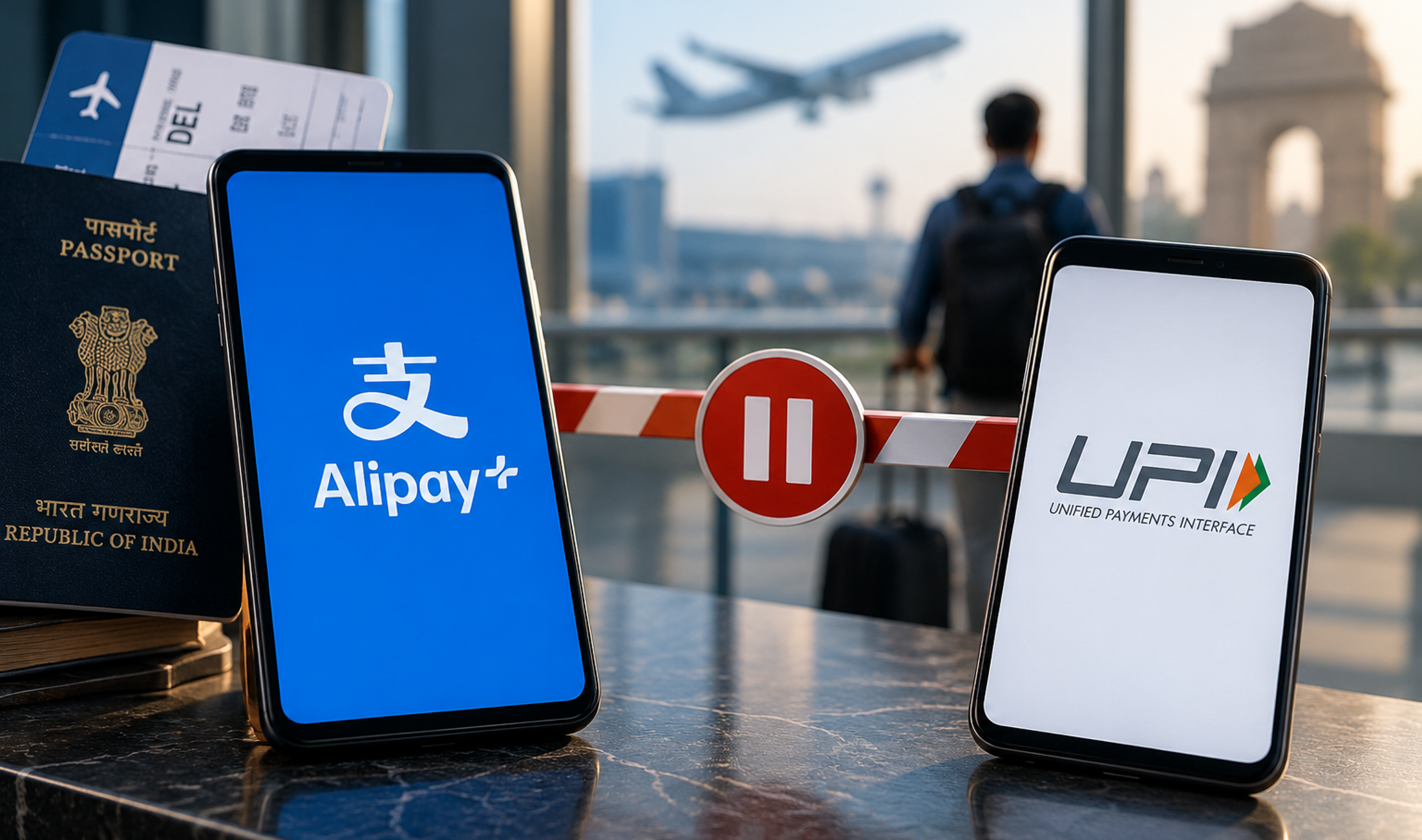
India has reportedly stalled a proposal to connect UPI with Alipay+ for cross-border payments, putting a potentially significant expansion of India’s instant-payment network on hold. Reuters reported on September 3, citing three people familiar with the discussions, that national-security concerns, the handling of customer data and financial-crime risks have become major obstacles to the proposed link. The development matters most immediately to Indian travellers because the plan was designed to let them use familiar UPI apps at a much wider network of merchants across Asia.
What has happened to the Alipay+ UPI proposal?
The proposal has not been publicly announced as cancelled. The more accurate description is that it has stalled. According to Reuters, India’s foreign ministry cited political grounds, while law-enforcement agencies raised concerns about money laundering, data breaches and cyberfraud. There is currently no clear path reported for resolving those hurdles.
That distinction is important. The information comes from people familiar with confidential discussions rather than a formal rejection notice from the government. India’s foreign, finance and home ministries, the Reserve Bank of India, the National Payments Corporation of India and Ant International did not respond to Reuters’ requests for comment. Until one of those bodies makes a public announcement, claims that the proposal has been permanently rejected would go beyond what is confirmed.
What was the Alipay+ UPI link supposed to do?
The proposal was aimed at making overseas payments feel more like paying a merchant in India. Alipay+ is a cross-border payment network operated by Singapore-based Ant International. Rather than requiring every merchant to integrate separately with every country’s wallet or payment system, Alipay+ can act as a connection layer between domestic payment methods and overseas merchants.

Under the first phase discussed earlier this year, Indian travellers would have been able to use UPI at merchants connected to the Alipay+ network in China, Hong Kong and other parts of Asia. Reuters reported that the network reaches more than 150 million merchants. A later phase could have enabled international visitors to use Alipay+ when paying merchants in India.
The idea fits into a much broader internationalisation of UPI. Headline Thread previously examined how UPI grew into a system handling tens of billions of transactions each month. The next phase of that growth increasingly involves making Indian payment credentials usable outside India rather than limiting UPI to domestic transactions.
Why is India concerned about data and security?
Cross-border payments involve more than simply recognising a QR code. Transaction information has to be routed, processed and settled across systems, while disputes, refunds, identity checks and fraud controls must work across jurisdictions. Reuters reported that Indian scrutiny has focused on how transaction data would be processed, stored and managed, as well as the mechanism for dispute resolution.
Law-enforcement concerns reportedly include the possibility of money laundering and data breaches that could expose customers to cyberfraud. These are not allegations that Alipay+ has committed such acts. They are risks Indian authorities are said to be assessing before allowing a China-linked payment network deeper connectivity with UPI.
The China connection adds a geopolitical layer. Ant International was spun out of Ant Group and is based in Singapore, but its historical links to China mean the proposal faces greater scrutiny than a routine technical integration. India imposed tighter restrictions on Chinese investment after the 2020 border clash, and financial infrastructure remains an especially sensitive area even as some economic restrictions have eased.
What would Indian travellers have gained?
For travellers, the attraction was convenience. Instead of relying primarily on international cards, cash or a destination-specific wallet, an Indian user could potentially pay an overseas merchant through a UPI app already connected to an Indian bank account. That could reduce the friction of adopting unfamiliar payment tools and make small purchases easier in markets where Alipay+ has broad merchant acceptance.
It would not necessarily mean every overseas payment was free or identical to a domestic UPI transfer. Cross-border payments still involve currency conversion, settlement arrangements, compliance checks and potentially fees. The final user experience and pricing would have depended on the commercial and regulatory framework agreed by the participating networks.
UPI is still expanding internationally without Alipay+
A stalled Alipay+ link does not mean India has stopped expanding UPI internationally. India already pursues payment connectivity through country-specific partnerships and other arrangements. NPCI has also been experimenting with services for foreign visitors. In February, for example, NPCI extended its UPI One World wallet to international delegates from more than 40 countries attending the India AI Impact Summit, allowing eligible visitors to make merchant UPI payments without an Indian mobile number or bank account.
UPI itself is also moving into new forms of payment. Headline Thread recently covered India’s work on agentic UPI payments that could allow authorised AI agents to make controlled transactions, showing that domestic innovation and international expansion are happening in parallel.
Why the decision matters beyond Alipay+
The bigger issue is the model India chooses for taking UPI global. Connecting with a large regional network can expand merchant acceptance quickly, but it also means agreeing on data governance, fraud controls, settlement and dispute processes with an outside operator. Bilateral links may give India tighter control but can take longer to build market by market.
That trade-off will become more important as Asian payment systems become more interconnected. Reuters cited FXC Intelligence estimates that outbound cross-border payments from the Asia-Pacific region could reach $23.8 trillion by 2032, nearly twice the 2024 level. Payment networks therefore have a strong commercial incentive to connect national systems before competing standards become entrenched.
At home, UPI is simultaneously becoming a broader everyday payments layer. The recent launch of bill payments inside WhatsApp in India is another example of payment functionality spreading into services users already open every day.
What happens next?
The immediate question is whether Ant International can address India’s concerns with a different technical or governance structure. A revised proposal could theoretically include tighter data localisation, clearer limits on data access, stronger audit controls or different settlement and dispute arrangements. No such revised framework has been announced.
For users, nothing changes today. Indian travellers should not assume that their UPI apps will soon work across the full Alipay+ merchant network unless NPCI, RBI, Ant International or another responsible authority confirms an integration. Existing overseas UPI arrangements continue separately.
The story is significant precisely because the proposed link promised scale. It could have given UPI users access to a huge overseas merchant network through infrastructure they already understand. India’s reported decision to stall it shows that when payment systems cross borders, convenience is only one part of the calculation. Control over financial data, fraud exposure and national-security risk can determine whether a technically attractive integration moves forward at all.